Is PAMM Trading Legal? Compliance and Investor Protection for Forex Brokers in 2026
Share this article
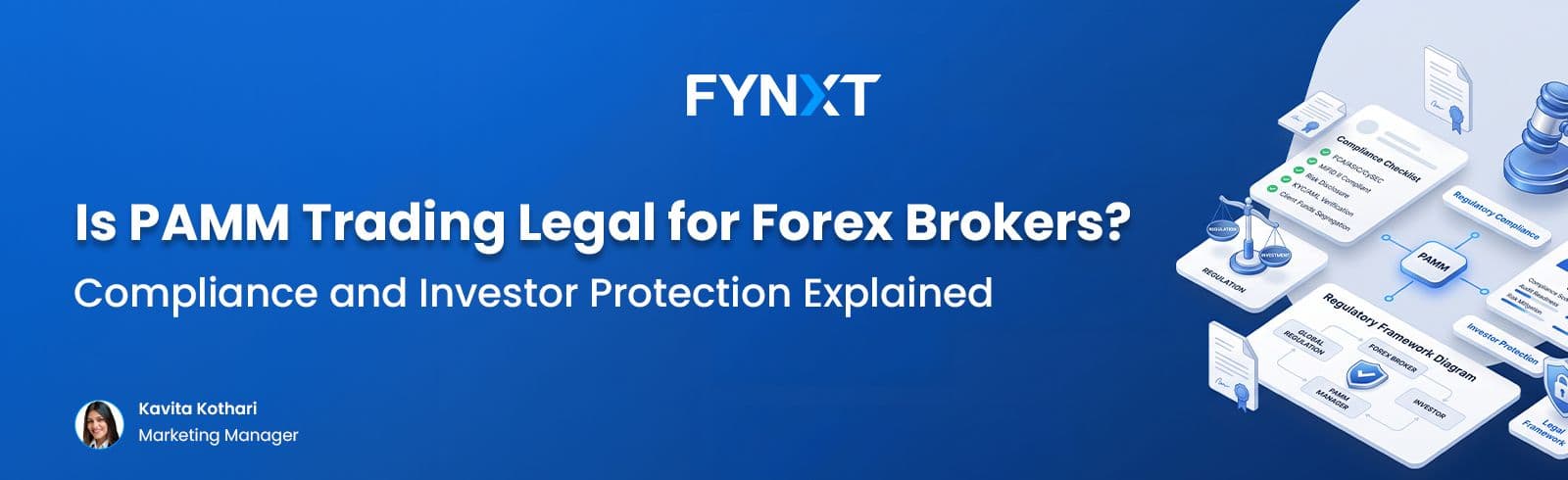
PAMM (Percentage Allocation Management Module) trading is legal in most major jurisdictions when your brokerage holds the permission that matches how the program actually works, usually portfolio management and sometimes fund management. The legal risk is misclassification, not PAMM itself. CySEC, the FCA, ASIC, and the DFSA all expect the same 5 investor protections before a pooled account goes live.
Short Answer: Is PAMM Trading Legal?
- PAMM is legal in the EU, the UK, Australia, and the DIFC when it runs under the right license. Offshore setups vary, so confirm locally.
- In the EU and UK, a manager trading your clients' money without per-trade approval is doing portfolio management.
- Pooling is the second trigger. It can turn a PAMM into a collective investment scheme in the UK or a managed investment scheme in Australia.
- The 5 protections regulators look for: segregated client money, stop-out levels disclosed up front, real statements, pre-agreed fees, and withdrawals that do not need the manager's sign-off.
- FYNXT PAMM ships these as settings you configure per strategy. Defaults include a margin call alert at 30% free margin and auto stop-out at 20%, plus a daily statement at 23:59:59 and exits with zero rollover delay.
This article is general information for brokers, not legal advice. Confirm your classification with local counsel before launch. If you are comparing vendors on features rather than compliance, start with our 2026 ranking of PAMM software for brokers.
Why is Misclassification the Real Legal Risk in PAMM?
Misclassification is the real risk because regulators judge a PAMM by what it does, not by what you call it. A PAMM pools investor capital into one master account, a fund manager trades that account once, and each investor's share of the profit or loss is applied in proportion to their stake.
Those same mechanics can land in different regulated activities depending on two details. The first test: does the investor approve each trade or hand over a standing mandate? The second: is the money pooled and managed as a whole, or kept in individual accounts?
The FCA drew the first line years ago, and it still stands on its copy trading page, last updated in July 2026:
"Where no automatic order execution occurs because client action is required before executing each transaction, the activity performed will not amount to portfolio management."
- Financial Conduct Authority, Copy trading (first published 2015, updated July 2026)
A PAMM never asks investors to approve trades. Under the FCA's test, that puts it on the portfolio management side of the line.
Regulators also have a reason to look hard. In IOSCO's May 2025 final report on online imitative trading, the FCA noted that "scam activity reported as utilizing copy trading has often in fact been investment management utilizing Multi Account Manager (MAM) or Percentage Allocation Management Model (PAMM) models." Legitimate brokers inherit that scrutiny whether they earned it or not.
Which Legal Category Does your Managed Account Structure Fall Into?
Your structure's legal category follows from who triggers each trade and whether money is pooled. PAMM and FYNXT Copy Trading are separate products for exactly this reason: pooled capital in one master account versus trades mirrored into individual follower accounts.
Managed account structures and their likely EU/UK classification (2026)
| Structure | Who triggers each trade | Money pooled? | Likely EU/UK classification | What pushes it into a heavier category |
|---|---|---|---|---|
| Signal service | Investor places or approves every trade | No | Investment advice or reception and transmission of orders | Adding automatic execution |
| Copy trading (auto-execution) | System copies trades under a standing mandate | No, individual accounts | Portfolio management (ESMA35-42-1428, paras 27-29) | Firm selecting or paying the lead traders (conflicts and inducements rules) |
| MAM | Manager trades a master and allocates to individual accounts | No, individual accounts | Portfolio management | Commingling investor balances |
| PAMM | Manager trades one pooled master account | Yes | Portfolio management, possibly also a collective investment scheme or fund | Pooled contributions plus management "as a whole" (FSMA 2000, s.235(3)) |
How is PAMM Classified in Each Jurisdiction?
PAMM classification varies by jurisdiction because each regulator fits it into activities it already licenses rather than a PAMM-specific category. The table below is the version to hand your compliance head. The detail for each regulator follows.
| Regulator | Likely classification of a pooled PAMM | Permission to check | Primary reference | Investor protection hooks |
|---|---|---|---|---|
| CySEC (Cyprus, EU) | Portfolio management under MiFID II; fund rules if it is structured like an AIF | Portfolio management in your CIF license | MiFID II Art. 4(1)(8); ESMA35-42-1428 (March 2023) | Client asset safeguarding; ex-ante costs and charges; past performance over up to 5 years |
| FCA (UK) | Portfolio management; possibly operating a collective investment scheme | Managing investments; scheme operation if pooled | FCA copy trading guidance (2015, updated July 2026); FSMA 2000 s.235 | CASS client money rules; suitability; periodic client reports |
| ASIC (Australia) | Managed investment scheme if pooled; MDA only if accounts stay individual | AFS license with MDA or scheme authorizations | RG 179.37; Corporations Act Chapter 5C | Quarterly MDA reports (RG 179.104); CFD order in force to May 23, 2027 |
| DFSA (DIFC) | Managing Assets; Managing a Collective Investment Fund if pooled | Category 3C license activities | DFSA Rulebook, GEN module | DFSA client money rules; applies inside the DIFC only |
How Does CySEC Treat PAMM in Cyprus and the EU?
CySEC treats discretionary management of client portfolios as portfolio management, a MiFID II investment service that your Cyprus Investment Firm license must explicitly cover. ESMA's March 2023 supervisory briefing on copy trading, written for national regulators including CySEC, sets the EU line: when trades execute "without any intervention by the client, other than the mandate in place," it is portfolio management.
A PAMM goes a step past copy trading because the money is pooled. Ask counsel whether your structure also touches Cyprus's alternative investment fund rules. The same briefing expects cost and charge disclosure before the service starts and past-performance marketing that covers the preceding 5 years.
How Does the FCA Treat PAMM in the UK?
The FCA classifies automatic trading under a client mandate as portfolio management, which needs specific permission and brings suitability, conduct of business, and periodic reporting duties with it.
Pooling raises a second question. Under FSMA 2000 section 235, an arrangement where participants lack day-to-day control, and where contributions are pooled or the property is managed as a whole, can be a collective investment scheme. That is a fair description of a PAMM master account. If your structure lands there, operating it is a separate regulated activity, and promoting an unregulated scheme is restricted under section 238. Investor money sits under the CASS client money rules either way.
How Does ASIC Treat PAMM in Australia?
ASIC regulates individually managed accounts as managed discretionary accounts (MDAs), but its rules bar pooling, so a pooled PAMM generally has to be run as a managed investment scheme. RG 179.37 states that an MDA provider "must not pool one client's portfolio assets with any other client's portfolio assets for investment purposes."
Outside MDA relief, Chapter 5C of the Corporations Act applies, and a scheme offered to retail clients usually needs registration and a responsible entity. Your leverage settings also sit under ASIC's CFD product intervention order, extended to May 23, 2027, which limits retail leverage to between 30:1 and 2:1 and standardizes margin close-out.
How Does the DFSA Treat PAMM in the DIFC?
The DFSA treats discretionary management of a client's investments as Managing Assets, and pooled structures can also count as Managing a Collective Investment Fund. Both sit in the Category 3C license band.
One detail catches brokers out. The DFSA regulates the DIFC only, so a PAMM offered from onshore UAE falls under a different regulator. The entity that holds your license decides which rulebook applies.
What Investor Protections do Regulators Expect From a PAMM Program?
Regulators expect 5 investor protections from a PAMM program, and they apply whether your license says portfolio management, fund management, or managed investment scheme.
- Segregated client money. Investor funds never sit with the manager's or the broker's own money. MiFID II safeguarding rules, the FCA's CASS regime, and Australian client money law all require this, and your PAMM ledger has to show each investor's share at any moment so the bank balance can be reconciled.
- Stop-out levels disclosed in advance. Investors should know the margin level that triggers an alert and the level where positions close before they subscribe. If your investors are retail CFD clients in the EU or UK, check how your settings interact with the regulatory margin close-out at 50% of required margin per account.
- Real statements on a fixed cadence. Statements show actual equity and closed trades, not projections, and the manager should not be the one producing them. For comparison, Australia's MDA regime requires quarterly reports within 1 month of each quarter end.
- Pre-agreed fees. Every fee, its rate, its timing, and any high-water-mark reset belongs in the terms before the first trade. ESMA expects ex-ante costs and charges disclosure before the service starts.
- Withdrawal that does not depend on the manager. An investor who wants out should not need permission from the person trading their money. If your program uses a notice period, disclose it up front.
What makes a PAMM Program Non-Compliant?
A PAMM program becomes non-compliant when any of those 5 protections depends on someone's goodwill instead of a rule in the system. These are the patterns to avoid.
- Running pooled management on the wrong permission. An execution-only or dealing license does not cover discretionary management of pooled money.
- Commingled accounts. Investor capital sitting in the manager's personal account, or in your operating account, breaks client money rules in every jurisdiction above.
- Fee changes without notice. Raising a performance fee mid-period, or quietly resetting the high-water mark, lets the manager charge again on gains investors already paid for.
- Statements the manager controls. If the fund manager produces the performance numbers, nobody independent is checking them. IOSCO's 2025 report flags falsified returns and leaderboards that hide risk-adjusted performance.
- Unlimited discretion with no exit. Manager discretion is the product. Discretion with no investor opt-out is the problem.
- Unvetted managers and unsupervised promotion. IOSCO's good practices call for manager selection and removal procedures and for monitoring marketing. If partners promote your strategies, that includes their material.
How Does FYNXT PAMM Map to Each Investor Protection?
FYNXT PAMM builds each of the 5 protections into strategy configuration, so the control runs the same way for every investor instead of depending on the manager. It runs natively inside FYNXT Forex CRM across MT4, MT5, and cTrader, which means fund management, KYC, IB commissions, and client records share one data model.
That shared record matters on the day your regulator asks for one investor's full history. Investors can also join through Digital Onboarding without an MT4/MT5 account, so KYC and the PAMM subscription sit in the same CRM.
The PAMM Investor Protection Control Map
The control map splits each protection into what FYNXT PAMM enforces and what your brokerage still owns. Software can run a stop-out. It cannot pick your license.
PAMM Investor Protection Control Map
| Protection | The question your regulator will ask | FYNXT PAMM control and default | What your brokerage still owns |
|---|---|---|---|
| 1. Segregated client money | Can you show each investor's share of the pool at any moment? | Per-investor virtual accounts updated the instant a trade closes, with zero rollover; investors are read-only on the master account | Holding investor money in segregated client accounts and reconciling them against the PAMM ledger on your regulator's schedule |
| 2. Disclosed stop-out | Did investors know the thresholds before subscribing? | Margin call alert at 30% free margin and auto stop-out at 20% free margin by default, each configurable per strategy | Publishing the thresholds in strategy terms and checking them against retail CFD close-out rules (see PAMM risk controls on MT4/MT5) |
| 3. Real statements | Are statements regular and independent of the manager? | Automated daily statement at 23:59:59 in the MT4/MT5 statement format; monthly statements and quarterly performance reports covering earnings and payables | Meeting any local minimum cadence and keeping statement records for your retention period |
| 4. Pre-agreed fees | Were all fees and resets disclosed before the service started? | 6 fee types toggled independently per strategy; performance fee charged only above the high-water mark; reset at month end, weekend, or 30 days from each investor's subscription date; settlement cycle set per strategy | Writing the fee schedule into client terms and giving notice before any change |
| 5. Independent withdrawal | Can investors leave without the manager's approval? | Full or partial withdrawal from the investor portal at any time; management fee pro-rated and settled on exit | Disclosing any notice period in your terms and paying out to the investor's verified account |
Worked Example: One Day in a $100,000 PAMM Pool
Here is what those controls look like on a $100,000 pool with 3 investors, a 20% performance fee, and Proportional by Balance allocation.
Worked example: proportional allocation, fees, and a partial withdrawal
| Step | Investor A | Investor B | Investor C | Control at work |
|---|---|---|---|---|
| Opening balance (share of pool) | $50,000 (50%) | $35,000 (35%) | $15,000 (15%) | Per-investor virtual accounts |
| Manager closes a trade for +$12,500 | +$6,250 | +$4,375 | +$1,875 | P&L applied the instant the trade closes |
| 20% performance fee on new profit ($2,500 total) | -$1,250 | -$875 | -$375 | Fee only above the high-water mark, on pre-agreed terms |
| Equity after fee | $55,000 | $38,500 | $16,500 | Shown on the 23:59:59 daily statement |
| Investor C withdraws $5,000 the next morning | $55,000 | $38,500 | $11,500 | No wait for a rollover window |
| New shares of the $105,000 pool | 52.38% | 36.67% | 10.95% | Allocation recalculated on remaining balances |
This example assumes only a performance fee is switched on, and fees settle on the cycle you set for the strategy. If you enable a management fee, FYNXT pro-rates it on Investor C's withdrawal. An exit fee, if configured, would apply at that same step, which is why it has to be in the terms from day one.
Notice what the investor never had to do. Ask the manager for a statement. Wait for a settlement window. Request permission to leave. That is what a compliant posture looks like in practice.
Want to see the control map inside a live strategy configuration? Book a Demo
PAMM Compliance Checklist: What to Do Before You Launch
Work through these 8 steps in order before your first PAMM strategy goes live, because each one depends on the one before it.
- Classify the structure (owner: compliance head and local counsel). Apply the two tests, automatic execution versus per-trade approval and pooled versus individual, and write the conclusion down.
- Confirm your license covers it (owner: compliance). Depending on step 1, that means portfolio management, Managing Assets, or scheme authorization. Decide whether each fund manager needs their own authorization or acts under yours.
- Set up segregation and reconciliation (owner: finance). Investor money goes into client accounts, and your PAMM ledger reconciles against them on your regulator's schedule.
- Vet your fund managers (owner: dealing and compliance). Check qualifications, trading history, and complaint records, and define how a manager gets removed. IOSCO lists both as good practice.
- Fix the fee schedule per strategy (owner: product). Choose the fee types, rates, high-water-mark reset, and settlement cycle, then publish them before anyone subscribes.
- Set and disclose risk thresholds (owner: risk). Configure margin call and stop-out levels per strategy and check them against retail CFD close-out rules.
- Lock the statement cadence (owner: operations). Daily, monthly, and quarterly, plus any local minimum your license adds.
- Approve marketing and partner promotion (owner: compliance and partnerships). Past-performance claims need a stated calculation method. If IBs promote your strategies through IB Manager, where they earn multi-level performance fees automatically, their material counts as your marketing.
Then run one test withdrawal end to end. If it needs the fund manager's sign-off anywhere along the way, fix that before launch.
The Bottom Line for Your Compliance Team
PAMM is a licensing question first and a software question second. FYNXT PAMM handles the system side of steps 3, 5, 6, and 7 in configuration. Steps 1, 2, 4, and 8 belong to you and your counsel.
Get the classification right, then make every protection a system rule rather than a manager promise. FYNXT's Brokerage Operating System already runs for 50+ global clients, including CMC Markets, Axi, and Exinity, and was named Best Broker Infrastructure Provider at the FM Awards 2025.
Frequently Asked Questions
Yes, PAMM trading is legal in most major jurisdictions, including the EU, the UK, Australia, and the DIFC, when the broker holds the permission that matches the structure. That is usually portfolio management, and sometimes fund or scheme authorization where capital is pooled. The risk comes from misclassification, so confirm your structure with local counsel before you launch a FYNXT PAMM program or any other.
Yes. In regulated jurisdictions, investor money must be held apart from the broker's and the fund manager's own funds under client money rules such as the FCA's CASS regime and MiFID II safeguarding requirements. Your bank account structure handles the segregation. Your PAMM system has to show each investor's share of the pool at any moment, which FYNXT PAMM does through per-investor virtual accounts.
The regulator that licenses your brokerage oversees your PAMM program: CySEC in Cyprus under MiFID II, the FCA in the UK, ASIC in Australia, and the DFSA in the DIFC. International bodies shape the rules too. ESMA issued supervisory guidance on copy trading in March 2023, and IOSCO published good practices for copy and imitative trading in May 2025.
It depends on the jurisdiction and your setup. In many regulated markets the manager either holds discretionary management authorization or acts under your firm's license and supervision, with your firm answerable for their conduct. IOSCO's 2025 good practices also expect brokers to vet each manager's qualifications and complaint history and to have a process for removing them. Confirm the model with counsel.
It can be. A PAMM pools investor capital into one master account that a manager trades as a whole, which matches the UK definition of a collective investment scheme in FSMA 2000 section 235. Australia's MDA rules forbid pooling, so a pooled PAMM there generally needs managed investment scheme treatment. Whether your program crosses that line is a question for local counsel.
PAMM investors should get regular statements showing actual equity, closed trades, and fees charged, generated by the system rather than the fund manager. FYNXT PAMM issues an automated daily statement at 23:59:59 in the MT4/MT5 statement format, plus monthly statements and quarterly performance reports. Check local minimums as well, since Australia's MDA regime requires quarterly reports.
They should be able to, and regulators look closely at programs where they cannot. In FYNXT PAMM, investors withdraw in full or in part from the investor portal whenever they choose, with no rollover wait. Any management fee is pro-rated on exit. If your own program terms add a notice period, disclose it clearly before the investor subscribes.
FYNXT PAMM turns investor protections into per-strategy settings: a margin call alert at 30% free margin and auto stop-out at 20%, both configurable, a daily 23:59:59 statement, 6 independently toggled fee types with high-water-mark rules, and anytime withdrawals. It runs inside FYNXT Forex CRM, so KYC, IB commissions, and fund records share one data model.