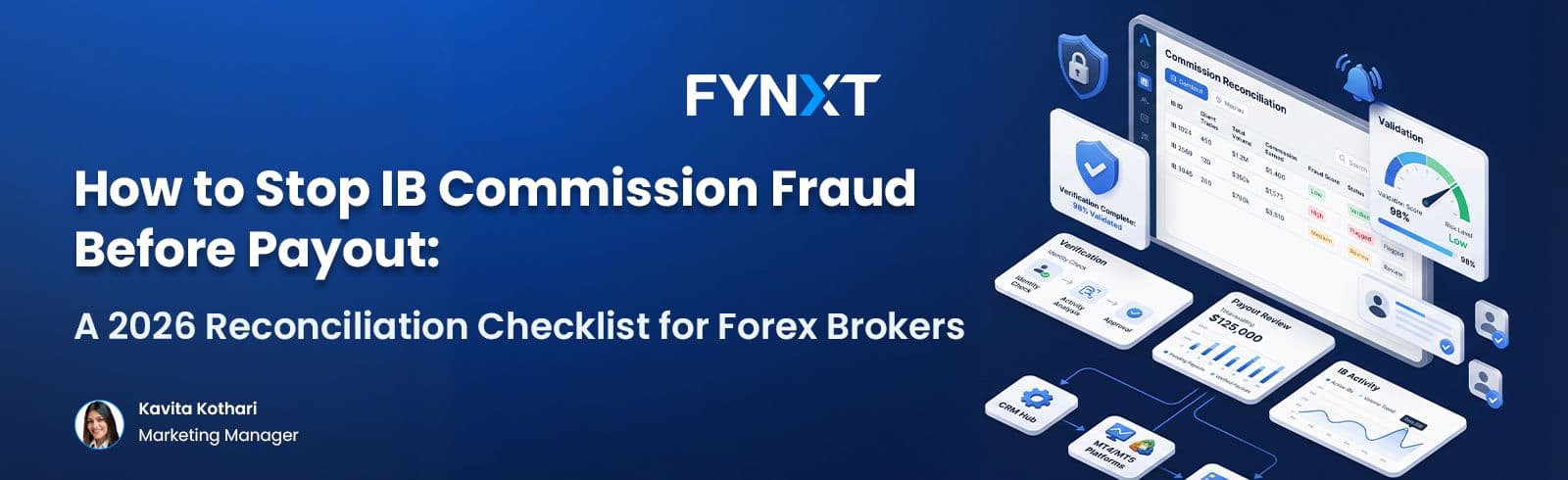
How to Stop IB Commission Fraud Before Payout: A 2026 Reconciliation Checklist for Forex Brokers
Share this article
IB commission fraud (self-referral loops, spoofed attribution, wash-trade volume inflation) is far cheaper to catch before payout than to claw back after. This checklist gives brokers five reconciliation checks to run before every payout cycle. FYNXT's IB Manager runs automated compliance checks before rebates become available for withdrawal, the same engine behind $450K+ in new rebates unlocked in 20 days for one FYNXT broker.
Short Answer
- Three fraud vectors drain IB payouts: self-referral loops, spoofed client attribution, and volume inflation through wash trades.
- Catching them before payout beats clawing them back after. A five-step reconciliation checklist closes the highest-risk gaps in every payout cycle.
- FYNXT's IB Manager runs automated compliance checks before rebates become available for withdrawal, not after the money moves.
- IB mapping and reassignment changes reflect within 60 minutes, with notifications and audit logs on every remapping, and rebate recalculations adjust hourly.
- What you'll need: CRM sign-up logs, IB assignment history, KYC records, raw trade logs, and withdrawal history. Most of it already lives inside your CRM and IB platform.
Why Pre-Payout Reconciliation Matters

A broker runs its monthly IB payout cycle, and three weeks later discovers that one IB gamed the client-attribution window to inflate their referred-client count. The commissions are already paid. The IB is gone. The finance team spends the next month trying to claw back money through a partner agreement that was never built for recovery. This is preventable, but only if the checks happen before the payout, not after.
Affiliate and referral fraud is not a forex-specific problem, but it is expensive everywhere it shows up. Industry estimates put affiliate fraud at roughly $3.4 billion a year in losses, with as much as 17% of affiliate traffic confirmed fake in some measurements. Forex IB networks carry the same exposure, with a sharper edge: the payout is cash commission, not a marketing budget line item.
Three Common IB Commission Fraud Vectors

Self-Referral Loops
An IB refers an account that is actually their own, or a close associate's, to collect commission on trading activity they effectively control. The giveaway is rarely obvious at a glance. It shows up in patterns: an IB whose “referred” clients trade in lockstep with the IB's own account activity, or accounts opened within minutes of the IB's own registration.
Spoofed Client Attribution
An IB manipulates which referral link or tracking ID gets credit for a client who was never actually referred, often by intercepting a client already in the broker's funnel. This inflates the IB's apparent acquisition performance and their CPA or per-lot payout, without the IB having done any real referral work.
Volume Inflation Through Wash Trades
An IB coordinates with a “referred” client to generate trading volume that does not reflect genuine market activity, inflating a per-lot or spread-based rebate. The trades net out to near-zero risk for the client, but the IB collects rebates on volume that was manufactured, not earned.
The 5-Step Pre-Payout Reconciliation Checklist
Run these five checks before every payout cycle releases, not after a client or IB disputes a number. Each step names who owns it, when it runs, and what it depends on.
Step 1: Cross-Reference Client Sign-Up Timestamps Against IB Assignment Dates
Owner: compliance or IB operations analyst. Timing: same day as any new IB assignment. Dependency: CRM sign-up log and IB assignment history. A client account opened before the IB relationship existed, or within minutes of the IB's own account, is the clearest signal of a self-referral loop.
Step 2: Flag Client Accounts Where the IB Email Domain Matches the Client Email Domain
Owner: compliance. Timing: weekly batch, and again immediately pre-payout. Dependency: KYC email and identity records. A shared email domain or near-identical personal details between an IB and their “referred” client is a direct self-referral indicator, not a coincidence worth ignoring.
Step 3: Audit Lot Volume Per Client Against Account Tenure Benchmarks
Owner: risk or dealing desk. Timing: each payout cycle, before release. Dependency: trade volume reports segmented by account age. A client trading disproportionate volume relative to how long the account has existed is either an exceptional trader or a wash-trading pattern, and the difference is worth confirming before the rebate goes out.
Step 4: Verify Payout Calculations Against Raw Trade Logs, Not Aggregated Reports
Owner: finance or IB operations. Timing: before every payout run. Dependency: raw trade log export, not the rolled-up commission summary. Aggregated reports smooth over the exact trades that generated a rebate; raw logs show whether the underlying volume was genuine trading or manufactured activity.
Step 5: Run Pre-Payout Reconciliation Against Withdrawal Patterns
Owner: risk. Timing: immediately before payout release. Dependency: withdrawal transaction history. A sudden large withdrawal shortly after a commission payout, especially from a “referred” client tied to a flagged IB, is a strong signal of recycled funds rather than organic trading.
How FYNXT's IB Manager Catches Discrepancies Before Payout

FYNXT's IB Manager runs automated compliance checks before rebates become available for IB withdrawal, not after the money has moved. The platform's rules and checks are designed specifically to stop spammers and fraudulent referral patterns as part of the core rebate engine, not as a bolt-on report a broker runs separately.
Reconciliation accuracy is built into the same layer. Rebate recalculations adjust hourly, using historical data to correct errors as they surface. Client reassignment between partners automatically triggers a rebate recalculation, and every remapping change is captured in reports with notifications and audit logs. IB mapping changes reflect within 60 minutes of a correction, so a discrepancy caught in Step 1 or Step 2 above does not sit unresolved for a full payout cycle waiting on a manual fix.
| Fraud Vector | Data Signal | How FYNXT's IB Manager Supports Detection |
|---|---|---|
| Self-referral loops | IB email domain matches client email domain; accounts opened minutes apart | Automated pre-payout compliance checks, plus a full audit trail of every IB assignment and reassignment to review |
| Spoofed client attribution | Referral credit does not match the client's actual acquisition history in CRM logs | Reassignment and recalculation engine updates rebates whenever attribution changes, with a logged history of every remap |
| Volume inflation via wash trades | Disproportionate lot volume relative to account tenure; near-zero net market risk | Hourly rebate recalculation against underlying trade data, surfaced before the payout clears |
“Supports detection” describes the automated checks, recalculation, and audit trail FYNXT's IB Manager provides; brokers still apply the reconciliation checklist above using this data.
“The FYNXT IB Manager allows us to improve flexibility in managing multi-tier IB structures while maintaining a seamless flow of data across our existing systems.” Mukesh Kachroo, Group Chief Information Officer, Exinity
| Dimension | Manual Reconciliation | FYNXT's Automated Reconciliation |
|---|---|---|
| Rebate recalculation frequency | Ad hoc, often monthly or after a dispute | Adjusts hourly using historical data |
| IB mapping and reassignment updates | Manual re-entry, often delayed | Reflects within 60 minutes, with notifications |
| Audit trail of remapping changes | Inconsistent, often untracked | Every remapping change tracked in reports |
| Pre-payout compliance check | Manual review, if run at all | Automated checks run before rebates become available for withdrawal |
| Typical detection timing | After an IB or client disputes a number | Built into the payout cycle itself |
What Goes Wrong, and How to Avoid It

Brokers most often lose the fraud-detection window in three ways. They reconcile against aggregated commission summaries instead of raw trade logs, which hides exactly the volume patterns that expose wash trading. They run reconciliation only after an IB or client disputes a number, instead of as a standing step in every payout cycle. And they treat IB fraud as a compliance-only problem, when it is really a finance and operations workflow that compliance should audit, not own alone.
Regulatory Considerations for IB Payout Reconciliation
IB commission fraud sits at the intersection of payout accuracy and AML exposure. Paying rebates to an IB whose “referred” clients turn out to be the IB's own accounts can look like fund recycling to a regulator, not just a commercial dispute. FCA, ASIC, and CySEC all expect brokers to maintain due diligence on partner relationships, not only end clients, and to show why a payout was approved, not just that it was calculated correctly. A pre-payout reconciliation checklist doubles as that evidence trail.
Vendor Landscape: Where Other Platforms Stand on Payout Integrity
TradeCore checks FTD count, deposit amount, active clients, and traded lots before a payout releases, with built-in duplicate-payment detection, a genuinely useful control that stops short of a fraud-vector-specific reconciliation guide. Nullpoint covers IP tracking, role-based permissions, and audit logging as general security features, not commission-fraud reconciliation. AltimaCRM's content here is a CRM feature roundup, not a fraud-prevention guide. None of this means these platforms cannot catch fraud; it means none currently publishes a reconciliation process built around these three specific vectors.
| Book A Demo |
Frequently Asked Questions
IB commission fraud happens when an introducing broker manipulates client attribution, referral volume, or trading activity to collect rebates they have not genuinely earned. It is not tracked as a forex-specific statistic, but affiliate fraud broadly costs an estimated $3.4 billion a year across industries (AffiliateBay, 2026), and forex IB networks carry the same exposure with cash commissions at stake.
A self-referral loop is when an IB refers an account that is actually their own or a close associate's, collecting commission on trading activity they effectively control. It typically surfaces through matching email domains, near-identical KYC details, or client accounts opened within minutes of the IB's own registration.
Spoofed attribution shows up when a client's referral credit does not match their actual acquisition history: a client already active in the broker's funnel suddenly gets attributed to a different IB. Cross-referencing sign-up timestamps against IB assignment dates, the first step in this checklist, catches most cases before payout.
FYNXT's IB Manager runs automated compliance checks before rebates become available for withdrawal, with fraud and spam-referral checks built into the core rebate engine. Reconciliation, reassignment, and error correction run on top of that, with mapping changes reflected within 60 minutes and every change logged for audit.
Manual reconciliation relies on periodic spot-checks against aggregated reports and usually surfaces problems only after a dispute. Automated reconciliation, as FYNXT's IB Manager runs it, recalculates rebates hourly, applies compliance checks before withdrawal, and logs every reassignment, catching discrepancies inside the payout cycle instead of after it.
Yes, but recovery is far harder. Once a payout clears, brokers are relying on a partner agreement's clawback terms, which many IB contracts do not clearly define. Pre-payout reconciliation, using raw trade logs and withdrawal-pattern checks, catches the same fraud vectors while the money is still recoverable.