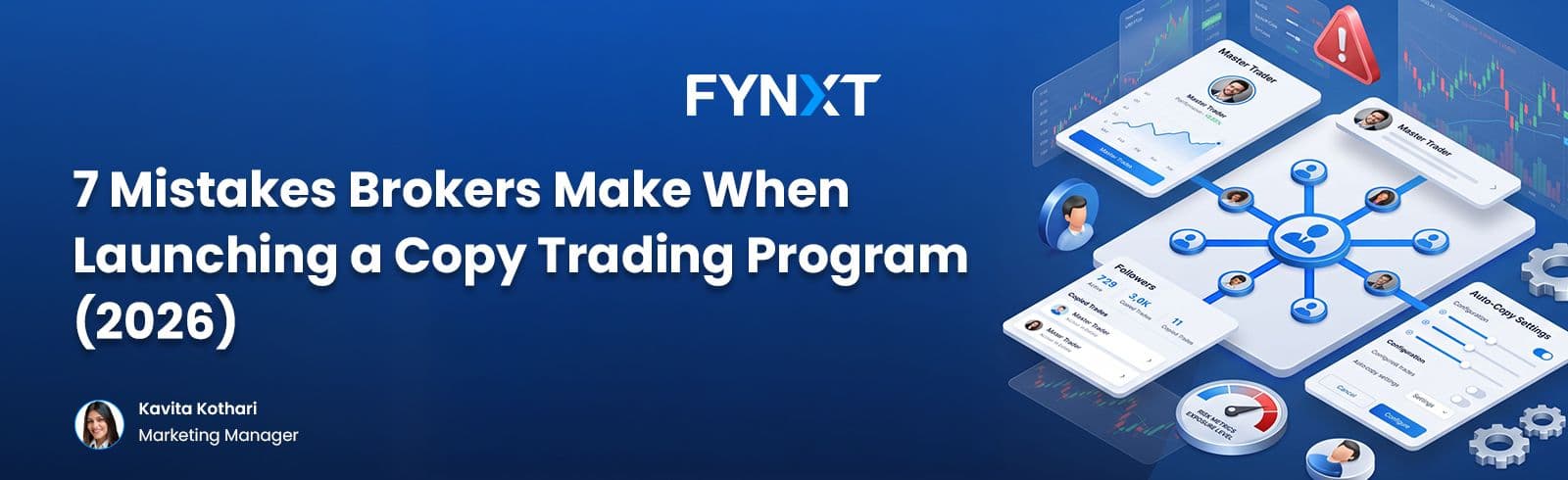
7 Mistakes Brokers Make When Launching a Copy Trading Program (2026)
Share this article
Most copy trading launches fail on operations, not features. This guide covers the 7 mistakes that cost brokers the most: fee transparency, risk caps, platform sync, provider vetting, copy ratio confusion, compliance, and drawdown visibility. FYNXT's Copy Trading addresses most of these with CRM-native controls, and brokers report 20% higher retention when the launch is done right.
Short Answer
- Most copy trading launches fail on operations, not the feature itself: fee transparency, provider vetting, and compliance classification cause more damage than any missing button.
- The 7 mistakes: no fee transparency framework, global instead of per-strategy risk caps, untested platform sync, no signal provider vetting, misunderstood copy ratios, ignored compliance classification, and no drawdown visibility.
- FYNXT's Copy Trading lets each investor choose their own allocation method and exposure multiplier, independent of the signal provider's own settings.
- Compliance classification for copy trading varies by jurisdiction, with the EU, UAE, and Australia each carrying different triggers for managed-account style oversight.
- Brokers that operationalize copy trading correctly see 20% higher retention; brokers that launch it carelessly get the trader drop-off copy trading was meant to fix.
Why Launching Copy Trading is an Operations Problem, not a Feature Problem

Adding a copy trading module to your platform is not hard. Managing it once real investor money is flowing through real signal providers is where launches go wrong. Most brokers underestimate the operational surface area: fee disputes, sync failures between platforms, an unvetted signal provider who blows up an account, a compliance question nobody answered before go-live. None of these show up in a demo. All of them show up in month two.
The stakes are real. FYNXT's own product research puts trader drop-off at 70% within the first 90 days, and roughly 66% of investors describe their own trading decisions as impulsive and emotionally driven rather than planned. Copy trading exists to fix exactly that problem, and brokers that operationalize it correctly see 20% higher retention as a result. Brokers that launch it carelessly get the drop-off without the retention lift.
Mistake 1: No Fee Transparency Framework Before Launch
Brokers launch without a documented fee-disclosure structure, and clients exit after the first payout surprises them. A transparent fee disclosure should state, per strategy, which of the three fee types are active (performance, subscription, trade/volume), the exact percentage or amount for each, the high-water mark reset schedule, and where the fee is deducted from. FYNXT's investor cabinet shows fees and charts before a client ever subscribes, so this disclosure has somewhere to live, not just a policy on paper.
Mistake 2: Risk Caps Set Globally Instead of Per-Strategy
A single risk limit applied across every signal provider ignores that strategies carry different volatility profiles. A provider trading a high-frequency scalping strategy and one running a slow trend-following approach should not share one exposure ceiling. FYNXT's Copy Trading avoids a single global cap by letting each investor set their own Multiplier on a provider's lot size, independent of the strategy's own settings; a cautious investor runs 0.5x exposure while a confident one runs 2x on the identical signal.
Mistake 3: Multi-Platform Sync Not Tested Before Go-Live
Brokers running MT4 alongside MT5, or adding cTrader later, discover sync lag issues only after client funds are already live in copied positions. Before go-live, test four things: a trade opened on the signal provider's platform mirrors correctly to followers on a different platform; lot sizing recalculates correctly across platform-specific minimums; a dropped connection on one platform doesn't silently desync followers on another; and sub-minimum lots are floored rather than rejected or over-allocated. FYNXT's engine supports full cross-server copying between MT4 and MT5, with cTrader on the same engine, but that architecture still needs a dry run before go-live, not an assumption that it works.
Mistake 4: No Signal Provider Vetting Process
Open enrollment for signal providers, with no minimum standard, lets poor-quality or inexperienced traders build a following before their track record has been tested. FYNXT lets a broker require a minimum account balance before a strategy can go public, and gate a new provider's strategy as Private or Password-protected during a probation period before it becomes visible on the public leaderboard. At minimum, pair that with a defined minimum trading history before a provider earns public visibility.
Mistake 5: Copy Ratio Logic Misunderstood by Clients
Clients don't understand the difference between proportional and fixed-lot copying, and complaints spike when their results don't match the signal provider's. FYNXT's investor cabinet requires each follower to choose their own allocation method before subscribing, with stats, fees, and charts visible first: Proportional by Equity scales to the investor's account size, Proportional by Balance does the same using balance instead of equity, Fixed Lot copies the same lot size regardless of account size, and Multiplier scales the provider's lot up or down by a set factor. A client who picked their method knowingly understands why their result differs from the provider's.
Mistake 6: Compliance for Managed Accounts Ignored
Copy trading can trigger managed-account or portfolio-management regulatory classifications that a broker's existing licence does not cover, and the trigger varies by jurisdiction. In the EU, automated trade-mirroring can fall under MiFID II's portfolio management definition depending on how much discretion the signal provider retains. In the UAE, automated investment services increasingly draw scrutiny from securities and virtual-asset regulators. In Australia, a copy trading service can require an Australian Financial Services Licence authorization for managed discretionary accounts. Confirm classification in every jurisdiction you operate in before launch, not after a regulator asks.
Mistake 7: No Drawdown Visibility for Copied Strategies
Brokers wait for a client complaint instead of surfacing drawdown proactively, and by the time a client calls, the losses are already realized. FYNXT's leaderboard displays drawdown alongside ROI, win rate, and total funds, refreshed every 30 minutes, and signal providers can push email alerts on investor-facing events. Give investors and your risk team standing visibility into drawdown, not just profit, rather than a static number someone has to remember to check.
The 7-Mistake Prevention Checklist
Use this checklist against any platform you're evaluating, including FYNXT's own. "Partially" means the underlying capability exists, but a broker policy decision or manual step is still required.
| Mistake | Does FYNXT Prevent This by Default? | Notes |
|---|---|---|
| No fee transparency framework | Yes | Investors view fees and charts before subscribing; three fee types are configurable per strategy |
| Global risk caps instead of per-strategy | Yes | Each investor sets their own Multiplier independent of the strategy's settings |
| Multi-platform sync untested | Partially | Cross-server copying (MT4/MT5, cTrader) is native; pre-launch testing is still the broker's task |
| No signal provider vetting | Partially | Minimum balance and Private/Password visibility are configurable; a formal track-record policy is the broker's to set |
| Copy ratio confusion | Yes | Investors choose their allocation method before subscribing, with stats and fees shown first |
| Compliance for managed accounts ignored | Partially | KYC, IB commissions, and investor records share one CRM record; jurisdiction classification is a legal determination |
| No drawdown visibility | Partially | Leaderboard shows drawdown every 30 minutes; a dedicated automated drawdown-threshold alert is not separately documented |
Vendor Landscape: What Other Platforms Publish on Launch Risk

B2Broker's B2Copy platform is among the most cited pages in this topic, and for good reason: its public materials document daily loss limits, maximum drawdown controls, and personal risk thresholds configurable per account or globally, alongside up to six broker-configurable fee types. What its public materials don't cover is the launch-operations side: a signal provider vetting standard, a cross-platform sync testing checklist, or a per-jurisdiction compliance framework. Widely-cited retail roundups like ForexBrokers.com compare 40-plus copy trading brokers from a trader's point of view, which is useful for a trader choosing a broker, not for a broker's internal launch checklist. Neither gap is a knock on either page; they are simply answering a different question than the one this checklist answers.
Frequently Asked Questions
Copy trading regulation varies by jurisdiction and depends on how much discretion the signal provider retains. Some regulators treat highly automated copying as a form of portfolio or investment management requiring specific licensing, including under MiFID II in the EU and AFSL rules in Australia, while others regulate it more lightly. Confirm your specific classification before launch.
A copy ratio determines how a signal provider's trade size translates to a follower's account. FYNXT offers four methods, Proportional by Equity, Proportional by Balance, Fixed Lot, and Multiplier, and each investor chooses independently. A 2x multiplier doubles the provider's lot size; a 0.5x multiplier halves it.
Brokers earn from performance fees on profitable trades above a high-water mark, subscription fees charged on a recurring basis, and volume or trade fees charged per copied lot. FYNXT settles all three fee types automatically into a linked account, with the broker controlling which fee types each signal provider can enable.
Underestimating the operational surface area is the most common mistake. Brokers treat copy trading as a feature to switch on rather than a workflow to manage: fee transparency, signal provider vetting, cross-platform testing, and compliance classification all need attention before go-live, not after client money is already following a strategy.
FYNXT lets brokers set a minimum account balance before a strategy can go public, and gate a new provider's visibility as Private or Password-protected during a probation period. Requiring a defined minimum trading history before public listing is a broker policy decision the platform supports, not something enforced automatically by default.
Yes. FYNXT lets each investor choose their own allocation method independently of the signal provider's settings, including a Multiplier that scales exposure up or down, a Reverse Copy option that inverts the signal, and the ability to pause copying without closing existing positions.