Copy Trading vs Social Trading: What's Actually Different for Brokers (2026)
Share this article
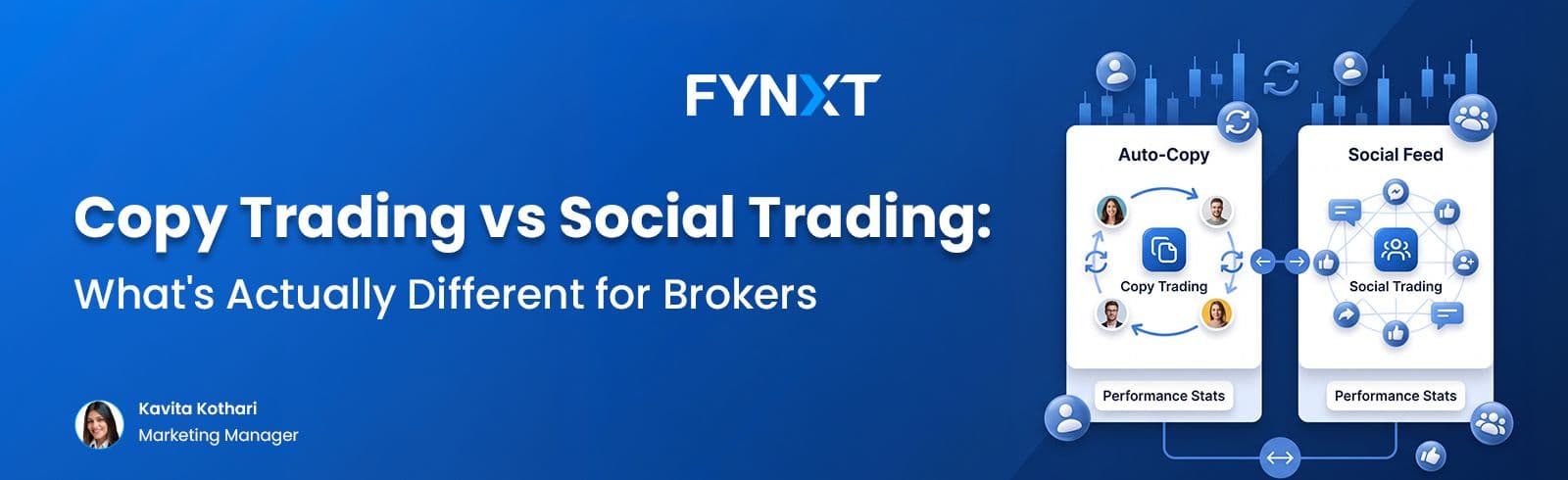
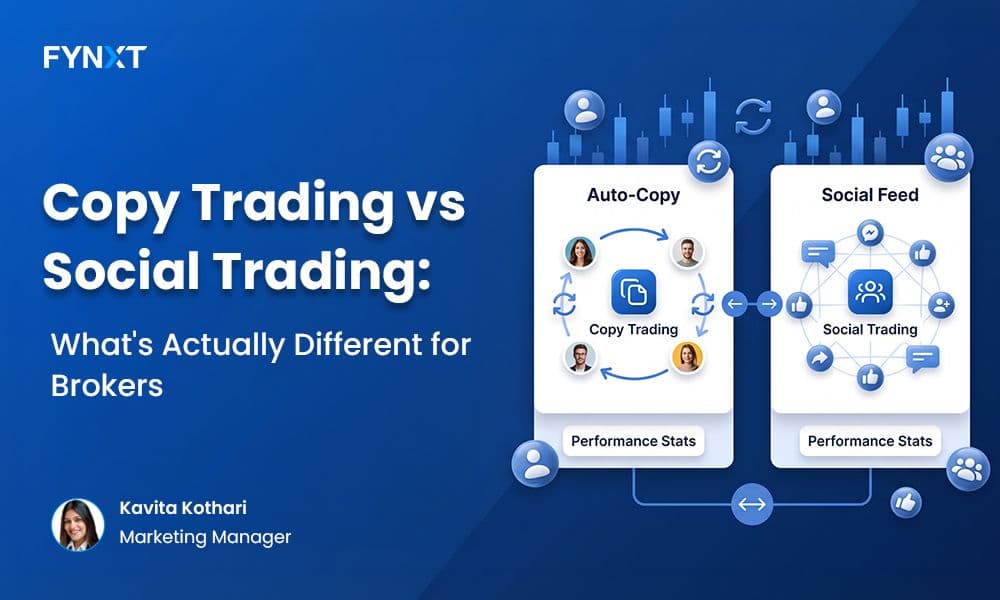
Copy trading is an execution feature: a follower account automatically replicates a signal provider's trades in real time. Social trading is broader: a discovery and community layer where traders browse rankings and choose who to follow, with copy trading as one possible piece of it. Four dimensions separate the two for a broker deciding what to build.
Short Answer: Copy Trading vs Social Trading, Defined
Brokers, vendors, and even regulators use these terms loosely, and the confusion has real operational consequences for whoever buys the wrong one:
- Copy trading is an execution-layer feature. A follower account automatically replicates a signal provider's trades in real time, with configurable lot sizing.
- Social trading is a discovery and community layer. Traders publish performance histories, followers browse rankings and choose providers manually, and execution may or may not be automated underneath.
- Social trading is the broader category; copy trading is the execution mechanism that often sits inside it, though a broker can run either one without the other.
- A broker buying a "social trading" platform expecting automated copy-execution, or the reverse, usually discovers the gap at integration, not before.
What is Copy Trading, From a Broker's Perspective?
Copy trading is an execution-layer feature where a follower account automatically replicates trades from a signal provider account in real time, with lot sizing configured proportionally, on a fixed basis, or by equity ratio. The broker's role is to operate the replication engine and manage the resulting risk exposure, not to run a community around it.
A copy trading system can exist with zero discovery features at all. A broker could, in principle, let a client subscribe to exactly one pre-approved signal provider with no leaderboard, no browsing, and no ranking, and it would still be copy trading in the full technical sense.
What is Social Trading, From a Broker's Perspective?
Social trading is a discovery and community layer where traders publish performance histories, followers browse rankings, and choose a signal provider manually before following them. Execution may or may not be automated once that choice is made.
Social trading includes copy trading as a subset when the follow-through is automated. Without automation, followers see a provider's trades and act on them manually, which makes the platform a discovery and information layer with no execution obligation attached to it at all.
Four Dimensions That Actually Separate Copy Trading From Social Trading
These four dimensions are what a broker evaluating either category should actually compare, rather than going by whatever a vendor happens to call its product.
| Dimension | Copy Trading | Social Trading |
|---|---|---|
| Execution automation | Every trade replicates automatically and in real time. | Varies by platform; some require the follower to manually confirm each copy. |
| Regulatory classification | Automated replication can be classified as discretionary fund management in some jurisdictions. | Manual per-trade confirmation typically avoids that classification. |
| Technology stack | A latency-sensitive execution bridge between provider and follower accounts. | A community database, ranking engine, and follower-facing discovery UI. |
| Revenue model for the broker | Spread or commission earned per replicated trade. | Can add subscription fees charged to providers for listing, on top of any execution revenue. |
How Does Regulatory Classification Differ Between the Two?
This distinction is worth taking seriously at the licensing stage, not just the product-naming stage, and it's worth confirming with counsel rather than treating the general pattern below as a ruling on any specific setup.
European Union (MiFID II)
Fully automated replication of a signal provider's trades has, in some interpretations, been treated as bordering on discretionary portfolio management, which carries its own licensing and disclosure requirements. Manual, follower-confirmed copying is generally viewed differently, since the follower retains the actual trading decision.
Australia (ASIC)
Automated copy arrangements can raise similar questions about who is exercising discretion over the follower's account. Brokers offering automated replication in this market typically build the compliance case around exactly where that discretion sits, rather than assuming the product's marketing label settles the question.
Which One Should a Broker Build First?
- Want managed-strategy exposure without PAMM-style licensing complexity? Copy trading is the more contained build, since each follower keeps their own account and a documented allocation method.
- Want a sticky community feature that lifts engagement and deposits beyond pure replication? Social trading is the path, though it means building or buying a ranking engine and discovery UI, not just an execution bridge.
- Want both? Look for one platform that offers both natively rather than bolting a community layer onto a pure execution tool, or the reverse.
Where Does FYNXT Copy Trading Fit in This Split?
FYNXT Copy Trading sits on the execution side of this line. It's real-time trade replication across MT4, MT5, and cTrader, with four configurable allocation methods, proportional by equity, proportional by balance, fixed lot, and multiplier, plus reverse copy on any of them. Three fee types, performance, subscription, and per-lot volume, settle automatically into the broker's CRM, and FYNXT reports 20% higher retention among copy trading users on its website.
It does publish a leaderboard where investors filter and compare signal providers before subscribing, which is a genuine discovery feature. But that's a browsing front-end sitting on top of an execution engine, not a full community layer: there's no forum, no user-generated discussion, no content beyond performance stats. FYNXT Copy Trading is a copy-execution product, not a social marketplace, and that's a deliberate positioning rather than a gap.
Want to see how the allocation methods and fee engine work on your own hierarchy? Book a Demo.
What Goes Wrong When Brokers Blur the Two Terms?
- Buying a "social trading" platform expecting real-time execution, then discovering followers have to manually confirm every copy.
- Building a pure execution engine and marketing it as "social trading," then fielding support requests asking where the community features are.
- Assuming a licensing approach that fits manual social trading also covers a fully automated copy engine, and finding out otherwise only at compliance review.
- Comparing vendors on price alone without checking which side of the line, execution or discovery, each one was actually built for.
How Do Vendors in This Space Use These Terms Today?
The definitional confusion in how these products are marketed is itself part of the problem this piece is written to fix.
B2Broker's B2COPY bundles copy trading, PAMM, and MAM into one installation, and its own marketing offers customers "social copy trading" as a single bundled choice. That's useful evidence the underlying engine is fully automated execution, but the "social" label gets applied to the whole bundle rather than to a distinct discovery layer.
ForexBrokers.com's roundup, its own URL combines "social" and "copy" trading, reviews retail platforms like eToro on ease of use and asset coverage. It's written for an individual trader choosing where to open an account, not a broker deciding what to build, so it has no reason to separate the two terms.
Social Trader Tools carries "social" in its name, but its own white-label page describes the product as a multi-account manager and trade copier with a leaderboard attached. That's a copy-execution tool with a ranking display bolted on, not a community platform.
Leverate's Social Trading page bundles a leaderboard with one-click automated mirroring under a single label. A separate Leverate blog post does offer a short, reasonably accurate definition distinguishing the two, but the product pages themselves don't carry that distinction through.
Brokeree's Social Trading for MetaTrader page is titled around the social term but describes itself as a "multi-server copy social trading solution," execution language wearing a social title.
Duplikium sits at the opposite end: a pure trade copier for individual traders and asset managers, with no leaderboard, no discovery layer, and no social framing anywhere on the page. It's a clean example of what execution without any social layer actually looks like.
Summary
The two terms describe different jobs. Copy trading is an execution engine that replicates trades; social trading is the discovery layer that helps a follower decide whom to replicate in the first place, with copy trading often sitting inside it as the mechanism. Getting the distinction right before buying or building saves a broker from finding the gap during integration, or worse, during a licensing conversation.
Frequently Asked Questions
No. Copy trading is an execution feature: a follower's account automatically replicates a signal provider's trades in real time. Social trading is broader, a discovery and community layer where traders browse rankings and choose who to follow. Copy trading is often the execution mechanism inside social trading, but a broker can offer either one alone.
It can be, depending on the jurisdiction. Fully automated replication of another trader's positions has, in some interpretations under frameworks like EU MiFID II, been treated as bordering on discretionary management. Platforms where the follower manually confirms each trade are generally viewed differently. Confirm the specific classification with counsel before launching.
A latency-sensitive execution bridge that can replicate a signal provider's trades across follower accounts in real time, configurable lot-sizing logic (proportional, fixed, or equity-based), a fee engine for settling performance, subscription, or volume charges, and a clear answer on regulatory classification before launch.
Yes. Copy trading is fundamentally an execution feature. A broker could let a client subscribe to one pre-approved signal provider with no leaderboard or browsing at all, and it would still be copy trading in the full technical sense. Discovery features are common but not required.
No. Some social trading platforms stop at discovery: followers see a provider's trades and act on them manually. Automated execution turns that discovery layer into copy trading as well, but the two can exist independently, and plenty of published social trading platforms only do the first.
Copy trading typically earns spread or commission on every replicated trade. Social trading can add a second revenue line on top of that: subscription fees charged to signal providers for being listed or ranked, independent of how much volume their followers actually generate.