
White Label vs Grey Label Forex Brokerage Models
Share this article

White label vs grey label forex brokerage models differ in infrastructure control, automation capability, compliance flexibility, and long-term profitability. White label offers structured technology ownership and scalable automation, while grey label provides lower upfront cost but limited operational independence. The choice directly impacts how efficiently you can launch, modernize operations, and scale globally.
Many brokerage founders compare models based only on setup cost. However, cost is not the defining factor. What determines long-term success is infrastructure control, revenue ownership, compliance structure, and automation readiness.
In today’s competitive FX/CFD landscape, brokers must launch faster, automate workflows, track IB networks accurately, and expand into multi-asset offerings without rebuilding their backend.
Choosing between a white label and grey label forex brokerage is not a structural formality. It is a strategic decision that influences growth velocity, operational efficiency, and scalability for years to come.
What Is a White Label Forex Brokerage?
A white label forex brokerage allows entrepreneurs or firms to launch their own brokerage brand using established trading infrastructure provided by a technology partner. The broker operates independently under its own branding while leveraging proven FX brokerage infrastructure.
Unlike building a brokerage from scratch, a white label forex brokerage removes the complexity of server setup, liquidity negotiations, and deep technical integration. Instead, it enables founders to focus on client acquisition, partner expansion, and operational growth while relying on a structured backend environment.
How a White Label Forex Brokerage Operates
A white label forex brokerage operates through a layered infrastructure model. The technology provider supplies the trading servers, liquidity connectivity, and risk framework. The broker receives structured server access and operates under its own brand identity. On top of this infrastructure, the broker integrates client management systems, IB management modules, and automation workflows.
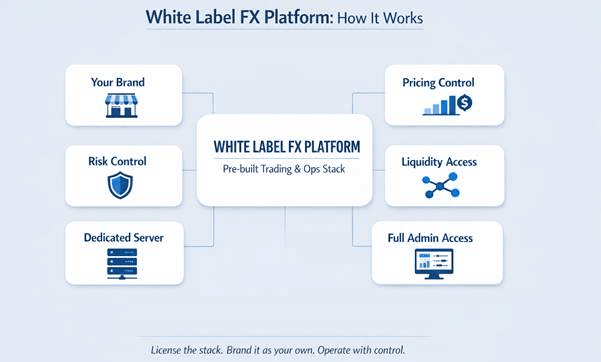
Under this structure, the white label forex brokerage maintains branding independence and operational visibility. Automation becomes possible because CRM systems, client portals, and IB tracking modules integrate directly into the brokerage front office. As a result, onboarding accelerates, reporting improves, and manual workload decreases.
Moreover, this structure supports scalability. Brokers can expand into multi-asset offerings such as CFDs, crypto, or equities without reengineering the backend. Therefore, the white label model creates a foundation for sustainable growth rather than short-term operation.
Who Is White Label Best For?
A white label forex brokerage is best suited for brokers who view their business as a long-term, scalable venture rather than a short-term revenue experiment.
It is ideal for:
- Entrepreneurs launching a serious brokerage brand
- FX/CFD brokers planning global expansion
- Multi-asset brokers targeting crypto, equities, and futures
- Firms building structured IB and affiliate networks
- Decision-makers prioritizing automation and compliance
White label forex brokerage models work best when the objective is control. Brokers who want ownership over onboarding workflows, IB commission structures, reporting frameworks, and automation processes require infrastructure visibility.
Moreover, white label becomes critical when scaling beyond a single jurisdiction. Regulatory requirements vary across regions. Payment processing rules differ. Reporting expectations increase. A white label structure allows brokers to adapt without depending on a master entity’s internal policies.
Simply put, white label is best for operators who want to modernize operations, accelerate growth, and scale globally.
What Is a Grey Label Forex Brokerage?
A grey label forex brokerage operates under a master broker’s infrastructure. While the brand may appear independent externally, backend control remains centralized under the master entity. This model prioritizes low entry cost and rapid setup but restricts operational flexibility.
Grey label forex brokerage models often attract first-time founders due to minimal capital requirements. However, the structural trade-offs become visible as the brokerage grows.
How a Grey Label Forex Brokerage Operates
In a grey label forex brokerage setup, the master broker retains full control of trading servers, liquidity, compliance oversight, and risk management. The grey label operator receives branding capability and access to basic reporting but does not control the core infrastructure.
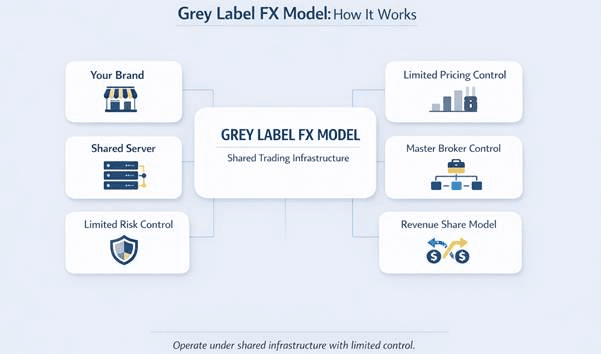
Under this model, the grey label forex brokerage focuses primarily on client acquisition while the master broker controls infrastructure and compliance. Because backend visibility is restricted, automation capabilities are limited. Customizing workflows or integrating advanced CRM systems becomes difficult.
As the brokerage attempts to scale, dependency increases. Expanding into new jurisdictions or adding multi-asset capabilities often requires renegotiation or migration. Therefore, while grey label reduces entry barriers, it constrains long-term flexibility.
Who Is Grey Label Best For?
A grey label forex brokerage is typically suitable for founders who prioritize minimal capital investment and short-term market testing.
It may fit:
- Small IBs transitioning into brokerage operations
- Local market operators with limited growth ambitions
- Entrepreneurs testing a specific geographic niche
- Founders comfortable operating under master broker dependency
Grey label works when the objective is entry, not expansion. It reduces technical complexity and lowers initial financial exposure. However, as trading volume increases and operational complexity grows, dependency can become restrictive.
If a broker plans to remain small and localized, grey label may suffice. However, if scalability, automation, and multi-asset expansion are part of the roadmap, limitations surface quickly.
White Label vs Grey Label Forex Brokerage: Direct Comparison
| Feature | White Label Forex Brokerage | Grey Label Forex Brokerage |
| Infrastructure Control | Structured server access | Minimal backend control |
| Branding Independence | Full brand ownership | Limited branding |
| Revenue Ownership | Higher margin control | Revenue split dependency |
| Compliance Flexibility | Greater operational flexibility | Controlled by master broker |
| Automation Capability | High with integrated systems | Limited automation |
| Multi-Asset Expansion | Scalable | Restricted |
| Customization | Flexible and configurable | Minimal |
| Migration Flexibility | Easier upgrade path | Complex and costly |
| Long-Term Profitability | Stronger margin sustainability | Margin compression risk |
The comparison highlights a clear distinction. Grey label focuses on affordability and speed of entry. White label focuses on control, automation, and scalability.
For brokers aiming to modernize operations and accelerate growth, infrastructure ownership becomes more valuable than initial savings.
Why Choose FYNXT for White Label Forex Brokerage Solutions
Choosing a white label forex brokerage model is only the first step. The real differentiator lies in the technology partner behind the infrastructure.
FYNXT is a Singapore-headquartered fintech SaaS provider offering a modular, low-code brokerage front office platform designed specifically for FX/CFD and multi-asset brokers. The platform is built to modernize operations and accelerate business growth through automation and integration.
A Modular, Low-Code Brokerage Front Office Platform
FYNXT delivers more than basic infrastructure. It provides a centralized brokerage front office platform that connects all operational layers.
Core modules include:
- Forex CRM
- Digital Onboarding
- Client Portal
- IB Manager
- PAMM
- Copy Trading
- Contest Manager
- White-Label Brokerage Solution
Each module integrates seamlessly, eliminating disconnected systems. As a result, onboarding, IB tracking, compliance workflows, and payout management operate within one structured ecosystem.
Manual processes slow brokers down. Therefore, FYNXT focuses on automation across the entire client lifecycle.
With FYNXT, brokers can:
- Automate KYC and onboarding workflows
- Centralize IB commission tracking
- Automate payout calculations
- Integrate 100+ payment and trading systems
- Scale multi-asset offerings without rebuilding infrastructure
This approach reduces operational friction while improving compliance readiness.
Enterprise-Grade Trust and Global Scalability
Serious brokers require enterprise-level security and reliability.
FYNXT provides:
- ISO 27001 certification
- 100+ integrations
- 50+ global brokerage clients
- $4M+ monthly settlements processed
- Award-winning technology recognition
The platform is designed to support startup brokers and enterprise operators alike. Whether launching in one jurisdiction or expanding across regions, the architecture remains stable and scalable.
For brokers evaluating white label vs grey label forex brokerage models, the question is not just which structure to choose. It is which technology foundation supports sustainable growth.
Choosing the Model That Lets You Scale
White label vs grey label forex brokerage models represent two different strategic directions. Grey label prioritizes affordability and simplicity. White label prioritizes control, automation, and scalability.
In today’s competitive FX and multi-asset landscape, brokers cannot afford disconnected systems, manual workflows, and revenue dependency constraints. Infrastructure must support growth from day one.
If the goal is to launch faster, automate workflows, modernize operations, and scale globally, the white label forex brokerage model provides the stronger foundation.
And when choosing a technology partner, selecting a modular, low-code, compliance-ready platform like FYNXT ensures that growth is not limited by infrastructure.
If you are evaluating your choices, speak with FYNXT to design a scalable, automation-ready brokerage from day one.
FAQs
1. How does revenue structure differ between white label and grey label brokerage models?
Revenue structure differs in terms of margin control and dependency. White label brokers typically retain greater pricing flexibility, while grey label brokers operate within commission splits defined by the master broker.
2. Which model offers more operational control for growing brokerages?
White label offers more operational control for growing brokerages. It provides structured server access and system integration capabilities, whereas grey label restricts backend visibility and customization.
3. What risks should brokers consider before choosing a grey label model?
Brokers should consider infrastructure dependency and limited scalability risks. If the business grows beyond initial projections, upgrading from grey label can require complex restructuring.
4. Does white label make it easier to expand internationally?
Yes, white label makes international expansion more manageable. Because the broker operates with greater infrastructure visibility, adapting compliance processes and payment integrations becomes more flexible.
5. How does backend visibility impact long-term brokerage growth?
Backend visibility improves reporting accuracy, automation capability, and risk control. Limited visibility can slow decision-making and restrict the ability to optimize operations.
6. Why do serious brokers eventually move toward white label models?
Serious brokers move toward white label models to gain independence and scalability. As trading volume and regulatory requirements increase, infrastructure control becomes essential for sustainable growth.