Why Asset-Centric Platforms Break When Brokers Go Multi-Asset
Share this article

Asset-centric platforms break in multi-asset brokerages because they tie operational logic to individual products. As brokers expand across asset classes, this approach increases coordination overhead, reduces operational visibility, and slows execution.
Asset-centric platforms are broker systems designed around individual products, where onboarding, compliance, payments, and reporting are tightly coupled to each asset rather than shared across the operation.
Most brokerages do not experience this failure immediately. Early expansion often looks successful. New products go live, volumes increase, and systems appear stable. The limitations only become visible when operations must scale consistently across products, regions, and regulatory environments. This is where asset-centric design begins to work against the business.
How Brokerages Typically Expand Their Technology Stack
Broker technology stacks usually grow incrementally, driven by product demand rather than long-term operational design.
- A core trading platform is launched for the first asset
- A CRM or back-office tool is configured around that product
- New assets are added using separate platforms or add-on modules
- Operational workflows are adapted per asset instead of reused
- Integrations are layered to bridge gaps between systems
This approach minimizes disruption in the short term. However, it assumes that onboarding, compliance, payments, partner management, and reporting should be handled differently for each product. Over time, the brokerage operates multiple parallel systems that must be coordinated manually.
Why Multi-Asset Broker Platforms Stop Scaling
The core issue with asset-centric platforms is not the existence of multiple systems. It is the impact created when operational coordination becomes fragmented. At scale, these limitations stop being technical inconveniences and start affecting business performance. Once asset-centric platforms reach multi-asset scale, five systemic issues emerge:
- Fragmented client identity
Clients exist as multiple records across products, requiring repeated onboarding, document collection, and approvals. - Duplicated operational workflows
KYC, approvals, withdrawals, and exception handling are recreated per asset, reducing automation effectiveness. - Inconsistent compliance enforcement
Compliance rules are applied at the product level, fragmenting audit trails and increasing regulatory exposure. - Unscalable partner and IB operations
Rebates, commissions, and reporting differ by asset, leading to manual reconciliation and payout delays. - Complex payment and settlement handling
Funding and settlement logic varies across assets, increasing operational effort and client-facing delays.
The following image highlights the most common business-level consequences brokers experience as asset-centric platform complexity increases:
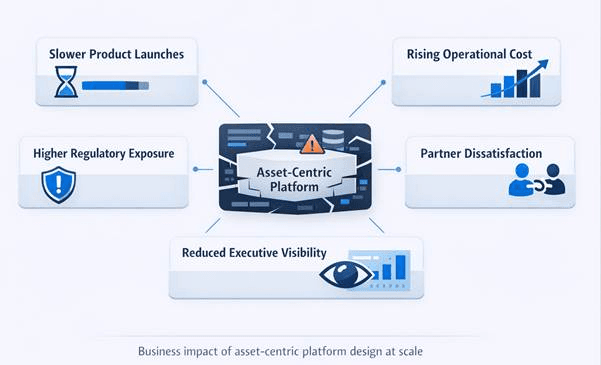
At this stage, growth becomes harder to manage despite strong demand. Decision-making relies on incomplete data. Teams spend more time coordinating systems than improving outcomes. The platform continues to operate, but it no longer supports efficient scale. At this point, platform complexity becomes a constraint on growth rather than a byproduct of it.
What Brokers Can Do to Avoid This Breakdown
Avoiding asset-centric failure does not require replacing every system. It requires changing how operational capabilities are structured and reused as the business expands.
- Separate operational logic from asset-specific platforms
- Centralize client identity across all products
- Standardize onboarding, compliance, and approval workflows
- Unify payments, settlements, and reconciliation processes
- Treat assets as configurable extensions, not operational drivers
The following benefits are typically seen when brokers adopt an operations-centric platform model:
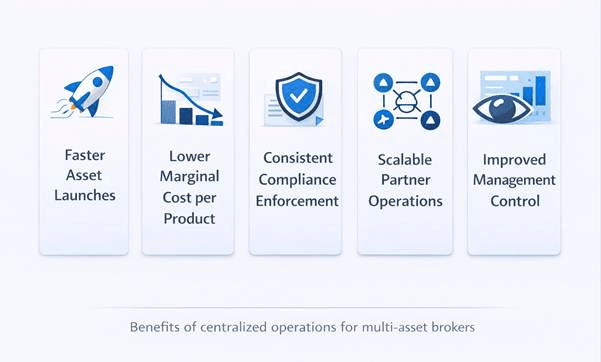
This approach allows brokers to grow product coverage without multiplying operational complexity. Scale becomes predictable, measurable, and controllable.
How FYNXT Helps Brokers Scale Multi-Asset Operations
FYNXT is built specifically to address the structural limitations of asset-centric platforms. As a low-code, modular digital front office, FYNXT enables brokers to centralize operations while supporting multiple asset classes, platforms, and regions from a single operational foundation.
- A unified client identity across assets, delivered through Forex CRM and Client Portal
- Centralized onboarding and KYC orchestration via Digital Onboarding
- Rule-based compliance and approval workflows managed within Forex CRM
- Integrated payments, settlements, and operational reporting using Payments & Reporting
- Scalable multi-level partner and rebate management powered by IB Manager
- Modular expansion into new business models with PAMM, Copy Trading, Contest Manager, and White-Label Brokerage
By decoupling operations from assets, FYNXT enables faster launches, lower operational overhead, and consistent control as brokers scale globally. Book a demo to see how FYNXT helps brokers modernize operations and scale multi-asset businesses with confidence.
FAQs
1. When should a broker rethink their platform architecture?
A broker should rethink platform architecture when adding a new asset requires new workflows, manual coordination, or custom development. This indicates the platform is product-led rather than operations-led and will struggle to scale further.
2. Is multi-asset complexity more of a technology or operating model problem?
Multi-asset complexity is primarily an operating model problem. Technology limitations usually surface because operational rules, governance, and workflows were not designed to be shared across products from the start.
3. How can brokers assess whether their current platform will scale long term?
Brokers can assess scalability by checking whether client onboarding, compliance rules, payments, and partner logic can be reused across assets without duplication. If each new product requires separate configuration or tooling, scalability is limited.
4. What risks do brokers face if they delay fixing platform fragmentation?
Delaying platform consolidation increases regulatory exposure, raises operational costs, slows product launches, and weakens management oversight. Over time, these risks become harder and more expensive to correct without major disruption.
5. How does an operations-centric platform improve executive decision-making?
An operations-centric platform provides a consolidated view of clients, performance, risk, and partners across all products. This allows leadership teams to make faster, data-driven decisions without relying on fragmented reports.