
- What Is a Multi-Asset Brokerage? The 2026 Definition
- The 10-Pillar Framework for Launching a Multi-Asset Brokerage in 2026
- 1. Business Plan & Commercial Strategy
- 2. Regulatory & Licensing Requirements
- 3. Banking Facilities & Payment Infrastructure
- 4. White-Label vs Platform Approach
- 5. CRM & Client Management Technology
- 6. IB & Partner Network Development
- 7. Marketing & Client Acquisition Requirements
- 8. Customer Support & Service Capability
- 9. Understanding Client Needs & Behaviour
- 10. Selecting the Right Technology Partner
- How FYNXT Supports These Considerations in Practice
- FAQS
Starting a multi-asset brokerage in 2026 requires more than licensing and technology. Founders must design operations, compliance, payments, partner management, and client lifecycle workflows that can scale across assets and regions from day one.
For brokerages, most long-term challenges arise from decisions made before launch. These decisions determine whether the brokerage scales smoothly or accumulates friction as volume, assets, and regions increase.
This article outlines ten things’ founders and operators need to understand before launching a multi-asset brokerage.
What Is a Multi-Asset Brokerage? The 2026 Definition
A multi-asset brokerage represents the consolidation of multiple financial products under a single operating and trading environment, rather than a collection of loosely connected systems.
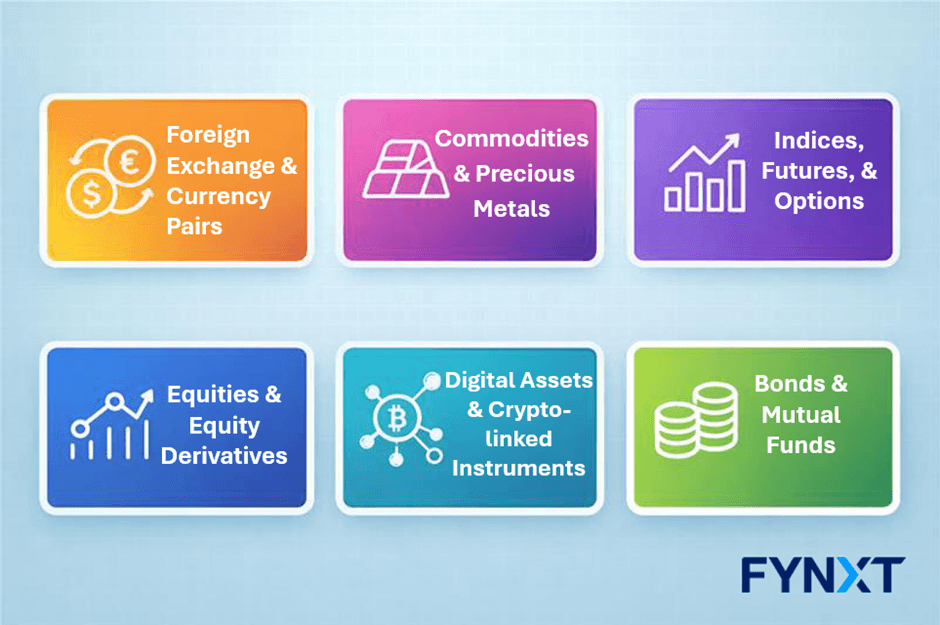
What truly defines a multi-asset brokerage is not the number of products offered. It is the ability to manage clients, onboarding, compliance, payments, and reporting through a single, consistent operating model across all asset classes.
The 10-Pillar Framework for Launching a Multi-Asset Brokerage in 2026
1. Business Plan & Commercial Strategy
A business plan should extend beyond revenue projections and pricing assumptions. It must explain how the brokerage will function once clients, partners, and transactions are active at scale.
From an operational perspective, a sound business plan addresses:
- How different client types (retail, professional, corporate) are expected to behave
- How revenue models (spreads, commissions, fees) interact with operational cost
- How growth affects staffing, systems, and compliance workload
- How margin pressure changes as competition increases
- How expansion into new regions or assets impacts cost structure
Brokerages that focus only on commercial projections often discover later that operational costs scale faster than revenue. A viable business plan aligns commercial ambition with operational capacity.
2. Regulatory & Licensing Requirements
Licensing is often treated as a one-time hurdle; however, it is an ongoing compliance commitment. Multi-asset brokerages are subject to overlapping regulatory requirements across reporting, disclosures, leverage controls, and auditability.
Beyond obtaining approval, brokerages must account for:
- Continuous reporting obligations and deadlines
- Jurisdiction-specific restrictions on leverage, promotions, and disclosures
- Requirements for record-keeping and auditability
- How regulatory updates affect existing clients and accounts
- Internal accountability for regulatory decision-making
A solution-oriented approach treats regulation as embedded logic, not manual oversight. When compliance rules are enforced through systems rather than people, consistency improves and risk exposure decreases.
3. Banking Facilities & Payment Infrastructure
Payments represent one of the most sensitive operational areas of a multi-asset brokerage. Even minor inefficiencies quickly translate into client dissatisfaction and regulatory attention.
Key considerations include:
- Availability of multiple banking and payment partners to reduce dependency risk
- Differences in payment behaviour across regions and client segments
- Settlement timelines and their impact on cash flow
- Reconciliation complexity as transaction volume increases
- Visibility of payment status for finance, support, and compliance teams
A well-designed payment infrastructure prioritises redundancy, visibility, and reconciliation rather than treating payments as isolated integrations.
4. White-Label vs Platform Approach
Choosing between a white-label setup and a more configurable platform is not simply a cost or speed decision. It is a decision about how expensive change will be after launch.
Before committing, brokerages should evaluate:
- How onboarding and approval rules can be modified post-launch
- Whether adding new regions requires development or configuration
- How additional asset classes interact with existing workflows
- The degree of dependency on vendors for routine changes
- The cost and disruption associated with future migrations
A solution-driven approach balances launch speed with long-term adaptability, recognising that regulatory and market conditions will evolve.
5. CRM & Client Management Technology
Client interactions span onboarding, trading, payments, and support. Fragmented systems increase response time, inconsistency, and operational overhead as scale increases.
A robust CRM and client management platform supports:
- End-to-end client lifecycle management from registration to active trading
- Configurable onboarding and KYC workflows based on client type and jurisdiction
- Centralised client profiles accessible to sales, operations, compliance, and support
- Rule-based permissions and account structures across multiple asset classes
- Integrated communication and activity tracking, reducing context loss between teams
- Operational reporting and client health visibility without manual data reconciliation
When CRM and client lifecycle tools are designed as the operational backbone, brokers gain consistency, speed, and better regulatory control.
6. IB & Partner Network Development
Introducing brokers and partners scale distribution faster than direct acquisition, but only when partner operations are system-driven. Manual IB handling typically fails once partner hierarchies deepen or commission models vary by product and region.
A capable IB management tool helps by enabling:
- Multi-level IB hierarchies where parent and sub-IB relationships are clearly defined
- N-level rebate and commission structures, allowing flexible payout logic across tiers
- Product- and region-specific commission rules without duplicating configurations
- Automated rebate calculation and settlement, reducing disputes and manual intervention
- Real-time visibility for IBs into performance, earnings, and client activity
- Audit-ready tracking of IB activity, payouts, and incentive changes
When IB logic is enforced through a dedicated system rather than spreadsheets or manual overrides, partner trust improves and operational risk declines.
7. Marketing & Client Acquisition Requirements
Many brokerages experience operational strain not because marketing is ineffective, but because acquisition scales faster than the systems designed to support it. Growth becomes unstable when marketing, compliance, and operations operate on different assumptions.
What to account for before scaling acquisition:
- Target only supported jurisdictions, where onboarding, payments, and compliance flows are fully operational
- Align marketing claims with actual processes, including onboarding timelines and funding availability
- Include operational cost in CAC, such as KYC reviews, payment exceptions, and withdrawals
- Incentivise sales on client quality, not just registrations or first deposits
- Plan for campaign-driven spikes, across onboarding, support, and finance teams
- Define escalation loops, between marketing, operations, and compliance
When marketing and operations are aligned, growth becomes controlled rather than reactive.
8. Customer Support & Service Capability
Support quality often reflects the health of underlying systems. As complexity increases, unresolved issues usually indicate structural gaps.
Support operations should be designed to:
- Access complete client context without switching systems
- Automate routine actions and common queries
- Route issues efficiently across departments
- Track recurring issues to identify process weaknesses
- Maintain consistent service across time zones and languages
Effective support reduces churn and provides early signals for operational improvement.
9. Understanding Client Needs & Behaviour
Assumptions about client behaviour often differ from real usage patterns. Operational data provides more reliable guidance. As brokerages scale across assets and regions, behavioural patterns begin to expose where workflows, product structures, or service models are misaligned.
Brokerages should continuously analyse:
- Onboarding completion and abandonment trends
- Asset-specific engagement and inactivity patterns
- Support interaction frequency by client segment
- Regional differences in expectations and behaviour
- Correlation between engagement tools and retention
This approach shifts decision-making from reactive fixes to continuous optimisation. Instead of responding to complaints or churn after the fact, brokerages can identify structural issues early and correct them at the workflow or system level.
10. Selecting the Right Technology Partner
Technology decisions made at launch have long-term consequences that extend beyond features or pricing. Multi-asset brokerages encounter limitations not because technology fails, but because it becomes difficult or expensive to scale or add new services.
A strong technology partner makes a difference by:
- Operations-first system design across onboarding, compliance, payments, and partners
- Modular architecture for adding regions or products without disruption
- Configuration over custom development for operational changes
- Brokerage domain expertise to address regulatory and scaling needs early
- Flexible integrations with trading platforms, liquidity, and payments
- Lower migration risk through a single, extensible operating framework
Partners such as FYNXT are structured around this operating-layer approach, where technology is designed to absorb complexity through configuration and modular expansion rather than forcing brokers into fixed workflows.
Selecting a technology partner with this mindset lowers operational friction over time and preserves the ability to respond to regulatory, market, and client-driven change.
How FYNXT Supports These Considerations in Practice
Addressing the ten considerations outlined above requires more than individual tools. In practice, brokerages struggle when onboarding, compliance, payments, partner management, and client engagement are handled in isolation. FYNXT is designed to act as a unified operating layer that connects these functions without forcing rigid workflows.
From an operational perspective, FYNXT supports brokerages through the following tools:
- Forex CRM: Centralises client onboarding, accounts, activity, and lifecycle data in one system for all teams.
- Digital Onboarding: Applies rule-based KYC and onboarding workflows by client type and jurisdiction with audit trails.
- IB Manager: Manages multi-level IB hierarchies with N-level rebates, automated commissions, and settlement reporting.
- Client Portal: Gives clients a single view of accounts, funding, documents, and activity across assets.
- Payments & PSP Orchestration: Unifies multiple PSPs into one view for transaction tracking, reconciliation, and exception handling.
- PAMM / Copy Trading Modules: Supports managed allocation and copy models with controlled permissions and reporting.
- Contest Manager: Runs rule-based engagement campaigns with tracking and compliance-aligned controls.
- Low-Code Configuration Layer: Enables changes to workflows, rules, regions, and products without custom development.
Rather than addressing isolated functions, FYNXT enables brokerages to absorb operational complexity through systems, allowing teams to scale activity, partners, and regions without proportional increases in manual effort.
If you’re planning to start a multi-asset brokerage in 2026, you can book a demo to see how FYNXT supports this operating model in practice.
FAQS
1. How long does it realistically take to launch a brokerage in 2026?
Most brokerages can launch in weeks rather than months if licensing, banking, and technology decisions are aligned early. Delays usually come from fragmented onboarding, manual compliance processes, or late changes in operating structure rather than from trading platform setup itself.
2. What usually causes brokerages to change their core platform after launch?
Brokerages typically change their core platform when systems cannot adapt to new assets, additional regions/regulations or expanded partner models. The issue is rarely missing features; it is usually rigid workflows, hard-coded logic, or poor integration flexibility that make change costly post-launch.
3. Is it better to launch with fewer assets and add more later?
Launching with fewer assets can reduce initial complexity, but only if the operating model is designed to scale. Brokerages struggle when early systems are built specifically for one asset class and cannot absorb additional rules, reporting, or permissions later without rework.
4. When should core brokerage technology be selected?
Core brokerage technology should be selected before licensing and market entry. It defines how onboarding, compliance, payments, and partners operate, and changing it later is costly.
5. Is it possible to stay compliant while expanding into new regions?
Yes, if compliance rules are configurable and centrally managed. Expansion fails when regional rules are hard-coded or handled manually instead of enforced through systems.
6. What role does an operating platform play beyond trading execution?
An operating platform coordinates client lifecycle, compliance logic, payments, partner management, and reporting across systems. Trading execution is only one component. Platforms such as FYNXT are designed to function as this operational layer, rather than as isolated tools.