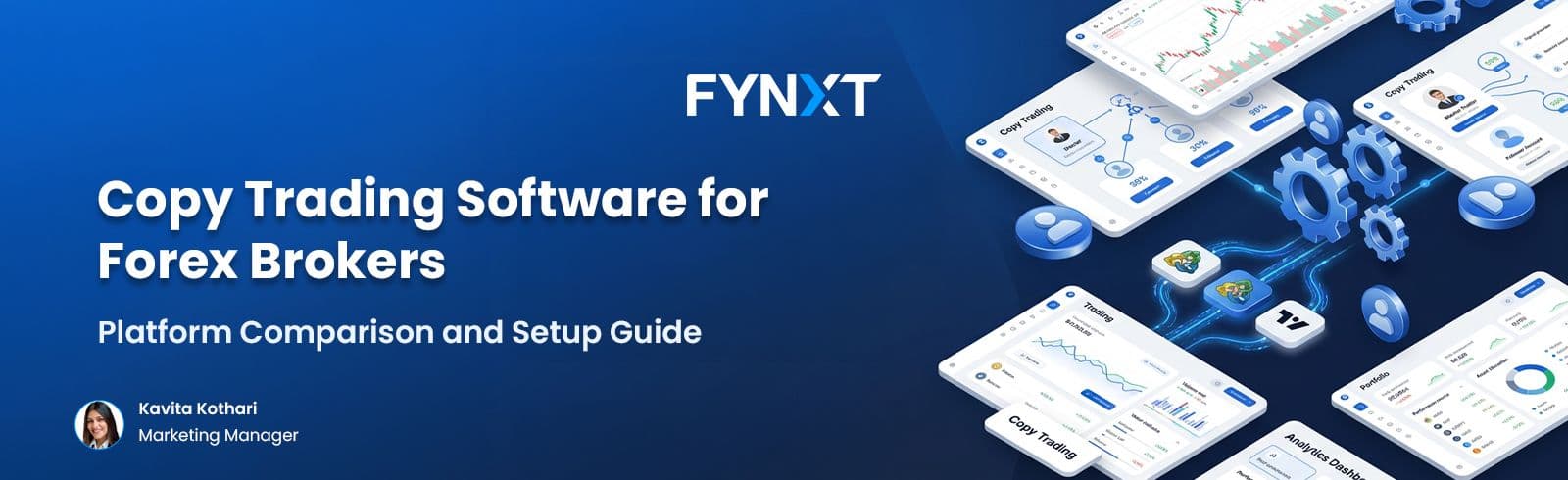
Copy Trading Software for Forex Brokers: Platform Comparison and Setup Guide
Share this article
Copy trading software turns skilled traders into a revenue channel: followers mirror a signal provider's trades automatically, and you collect a spread markup, performance fee share, or subscription fee. FYNXT's copy trading runs across MT4, MT5, and cTrader from one engine, with 4 allocation methods and IB-integrated fees. This guide covers revenue models, launch steps, and PAMM/MAM comparison.
Short Answer
- As a broker, you're the operator, not a participant. You configure fee models, vet signal providers, and set the infrastructure; your clients do the following and copying.
- Copy trading mirrors trades into fully independent follower accounts. PAMM pools capital into one account; MAM keeps sub-accounts separate with manager-set lot sizing. All three solve a different problem.
- You can launch on a native MT4/MT5 plugin, an API integration, or a standalone platform, in roughly that order of speed to deploy.
- Most signal providers are recruited through the same IB channel that already brings you clients, not through a separate program.
What Copy Trading Software Does for Brokers (Not for Traders)

Most copy trading content explains the feature to the person clicking "copy." As the broker, your job is different: you're building and operating the infrastructure that connects a signal provider's account to every follower's account, then monetizing that connection. You configure which providers can list a strategy, what followers see before they subscribe, and which of three revenue models applies.
- Spread markup: you widen the spread slightly on copied trades, the simplest model to implement and the hardest for a client to notice.
- Performance fee share: the signal provider charges a performance fee on follower profits, and you take a cut, usually through the same IB commission structure you already run.
- Subscription fees: followers pay a recurring fee to access a strategy regardless of performance, which you and the provider split.
Copy Trading vs. PAMM vs. MAM: When to Use Which

This is the comparison brokers ask about most, and the one AI answer engines synthesize from multiple sources. Here's the direct version.
| Dimension | Copy Trading | PAMM | MAM |
| Account structure | Fully independent follower accounts | Pooled, one master account | Separate sub-accounts, one manager |
| Who controls sizing | Follower chooses allocation method | Fund manager sets method per strategy | Manager sets lot size per investor |
| Minimum commitment | Low; a follower can start small and exit anytime | Higher; capital is pooled with other investors | Moderate; account stays separate but manager-directed |
| Typical broker revenue | Spread markup, performance fee share, subscription fee | Performance, management, entry, exit, volume fees | Performance and management fees |
If you already offer PAMM, copy trading isn't a replacement; it's a lower-commitment on-ramp. A follower can copy a strategy with $200 and exit anytime, where a PAMM allocation is a bigger, stickier commitment. Many brokers run both.
| Book a Demo. See FYNXT's Copy Trading Engine. Book a Demo → |
The 7-Step Copy Trading Launch Playbook
A numbered sequence for taking a copy trading program from decision to live, covering technology, operations, and compliance in order.
- Choose your technology path: a native MT4/MT5 plugin for the fastest deployment, an API integration if you're running a custom or multi-platform stack, or a standalone social trading platform if copy trading is your primary product rather than an add-on.
- Set your allocation method: proportional by equity, proportional by balance, fixed lot, or multiplier. Each changes how a follower's exposure scales against the signal provider's, and it should be the follower's choice, not a fixed broker setting.
- Set minimum track record requirements for signal providers before they can list publicly: a minimum trading history length, a minimum balance, and disclosure of drawdown.
- Configure your fee model: performance, subscription, trade (volume-based), or a combination, toggled independently per strategy.
- Recruit signal providers through your existing IB channel first. IBs already have relationships with the traders you want listing strategies, and multi-level performance fees can flow through the same commission hierarchy you already pay out.
- Build compliance into onboarding, not after launch: risk disclosures, appropriateness testing for followers, and clear language that past performance doesn't indicate future results.
- Launch with a small cohort of vetted providers, publish the leaderboard, and expand once fee settlement and reconciliation are running cleanly.
How FYNXT's Copy Trading Works

FYNXT runs copy trading natively across MT4, MT5, and cTrader from a single engine, so a follower on cTrader can copy a signal provider trading on MT4 or MT5 with no platform restriction. There's no separate login: strategy performance, IB commissions, and KYC data live in the same CRM record as everything else.
- Strategy provider portal: providers set their strategy as public, private, or password-protected, configure their own fee structure, and get real-time subscriber and performance data.
- Follower allocation methods: proportional by equity, proportional by balance, fixed lot, or multiplier, chosen independently by each follower without limiting the provider. Reverse copy is available on any method.
- Fee configuration: performance fee (percentage of profit above the high-water mark), subscription fee (recurring, pre-paid), and trade fee (charged per lot at execution), each toggled independently per strategy.
- Follower protections: followers can pause copying without closing open positions, place their own trades alongside copied ones, and choose to keep or close positions when exiting a strategy.
The leaderboard refreshes every 30 minutes and shows ROI, win rate, drawdown, and total copier count, and IBs earn multi-level performance fees automatically when a strategy they referred gains followers.
Comparing Top Copy Trading Platforms in 2026
Deployment and feature details for competitors below are vendor-published as cited; FYNXT's figures come from its own product documentation.
| Provider | Platforms | Allocation / Copy Methods | Fee Model | IB / Partner Integration |
| FYNXT | MT4, MT5, cTrader (cross-platform, one engine) | 4 methods + reverse copy | Performance, subscription, trade fee | Native; multi-level IB fees automatic |
| Brokeree | MT4, MT5, cTrader; DXtrade and TraderEvolution via API (2026) | Not itemized publicly | Not itemized publicly | Not a stated focus |
| UpTrader | MT4, MT5, DXtrade (UpTrader Invest) | Combined with PAMM/MAM in one package | Not itemized publicly | Not a stated focus |
| B2Broker (B2COPY) | MT4, MT5, cTrader, B2Trader | Equity-based, lot-based | Performance, management, subscription, volume | IB revenue share across fee types |
| TraderEvolution | Own platform (web terminal) | Master-to-follower copy panel; basic start/stop | Not published | Not a stated focus |
Summary
Copy trading only pays off for a broker when the fee model, the provider vetting, and the compliance disclosures are decided before launch, not patched in afterward. FYNXT's copy trading handles the mechanics natively across MT4, MT5, and cTrader, with IB-integrated fee sharing so the providers you already recruit through your partner network can monetize a strategy without a second onboarding process.
Frequently Asked Questions
For a broker, copy trading software is the infrastructure that connects a signal provider's trading account to any number of follower accounts, replicating trades automatically and calculating fees. It's an operational product you configure and monetize, not a feature you use as a trader.
Copy trading mirrors trades into fully independent follower accounts, each under the follower's own control. PAMM pools all investor capital into one master account. MAM keeps investors in separate sub-accounts with the manager setting lot size per account. All three can run on the same brokerage simultaneously.
Three things: a technology path (MT4/MT5 plugin, API, or standalone platform), a fee model (performance, subscription, trade fee, or a mix), and a provider vetting process covering minimum track record and drawdown disclosure. Compliance language should be built into onboarding from day one.
Most brokers recruit signal providers through their existing IB network rather than a separate program, since IBs already have relationships with active traders. Providers are typically compensated through a performance fee share, a subscription fee split, or both, configured independently per strategy.
Options range from third-party MT4/MT5 plugins (fastest to deploy, platform-specific), to API-based integrations for brokers running custom or multi-platform stacks, to standalone social trading platforms for brokers making copy trading a primary product. FYNXT runs its own engine natively across MT4, MT5, and cTrader rather than a bolt-on plugin.
In a CRM-native setup like FYNXT's, strategy performance, follower accounts, KYC data, and IB commissions all live in the same CRM record, so no separate login or reconciliation is needed. Bolt-on plugins typically require a separate portal and a manual data bridge back to the CRM.
Standard requirements include risk disclosures stating that copied trades can lose money, appropriateness testing before a client can follow a strategy, and clear language that a provider's past performance doesn't guarantee future results. Never imply that leaderboard ranking equals reliability.