PAMM or copy trading: which should you launch first?
It's the first question every firm asks, and you don't have to answer it permanently. Both run on the same allocation engine, the same leaderboard and the same admin. Many firms launch copy trading first for client engagement, then add PAMM to bring in professional money managers.
A PAMM investor holds no real position, so no platform minimum applies. A copy trading follower does – and a sub-minimum copy rounded up would silently over-leverage a small account. So copy trading skips it instead, and logs the skip with the calculated value and the threshold that caused it.
Investors join and exit the moment they decide.
Legacy PAMM plugins batch allocations onto a rollover cycle. The investor clicks, and then nothing happens – for thirty minutes, or three days. That gap is where your conversion goes.
Allocation runs on every trade close, not on a batch.
The allocation engine is the product.
Everything else on this page is a way of configuring one thing: how a master's trade becomes N investors' positions, across five platforms and two position models, without anyone's share drifting. That is the hard part, and it is where the engineering lives.
Real-time, on every trade close
Joins, top-ups, partial withdrawals and exits all process the moment they happen. No batch window, no queue.
0.00001 lots, with drift control
Each share rounds independently, so the sum can differ from the master's volume by a hair. That residue is tracked, corrected against the largest allocation, and never allowed to accumulate.
Positions are verified, not assumed
An automatic cycle compares every investor's actual position against the expected aggregate several times an hour, auto-corrects rounding-level differences and escalates anything larger. Silently drifting positions are not tolerated by design.
Your manager trades Hedging on MT5. Your investor's account is Netting on cTrader.
Netting and Hedging are structurally different position models. FYNXT detects the mode automatically on all five platforms, locks it at first subscription so allocation history can never be corrupted, and translates events with no per-strategy setup.
Nobody has to configure anything, and nobody's allocation drifts.
Flip between them.
Same engine, same leaderboard, same admin – two different shapes for the investor. Pick a side and the whole panel turns over.
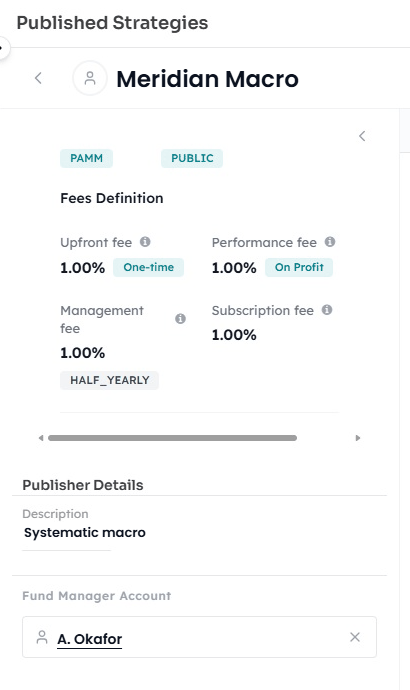
Pooled fund management with virtual investor accounts.
The investor subscribes through your portal and receives a virtual account with live balance, equity, margin and free margin. No MT4, MT5 or cTrader account to create, no platform login, no extra onboarding friction – which is exactly why PAMM converts.
Each investor's share of the master's volume tracks their share of total pooled balance.
Margin call and stop out, per investor
30% margin call and 20% stop out by default, applied to each virtual account individually. One investor's exposure never decides another's.
Exit settles to the cent
Round-up close settlement on exit, real-time top-ups and partial withdrawals, and concurrent exits that still reconcile exactly.
Fees that settle themselves – and can't be gamed.
Performance fee applies only to growth above the high-water mark. The mark scales up on deposit and down on withdrawal, proportionally – so an investor cannot move money in or out to reset it, and is never charged on capital they withdrew.
The recovery from $10,800 back to $12,000 is not new profit – it's the investor getting their own money back, and it is never charged. Only the $600 above the previous mark is.
On profit above the high-water mark only – never in drawdown.
A periodic charge on assets under management.
A recurring charge for access to the strategy.
A one-time charge taken at subscription.
Applied on early withdrawal, on the manager's declared terms.
A per-trade charge on allocated volume.
Pooled fund management justifies management and upfront fees – a manager is running a book. The coupon module lets them discount any of these for a campaign without duplicating the strategy.
Built so nobody is over-exposed or over-charged.
Follower protection is engineered, not promised. Move the follower's equity down and watch what the engine does when the calculated volume falls below the platform minimum.
The fee-settlement preview
Before any action with a financial consequence, the follower sees a dry run of the real settlement: accrued performance fee, subscription fee impact, resulting balance. The amount charged on confirmation must match the preview exactly – and if market movement makes a preview stale, the platform re-prices it rather than silently charging something different.
Risk management, per subscription
Floating loss, total loss and total profit levels, each paired with a trading action and a subscription action. The follower decides in advance what happens; the platform never assumes a default.
Every skip is logged
Placed, skipped, filtered and corrected copies all land in a log with the calculated value and the threshold that produced the outcome. Your compliance function can reconstruct any decision the engine made.
Every fee is a line item on both sides. Every exit reconciles to the cent. Every skipped copy is logged with the reason.
Five platforms. One strategy.
A money manager's strategy is not tied to a platform. If you migrate, or add one, the manager keeps trading the same strategy – no rebuild, no re-onboarding of investors, no conversation with your managers about why their book has to move.
That's a switching cost for your competitor and a retention argument for you.
Copy between any pairing
A provider on MT5 and a follower on cTrader is a supported configuration, not a workaround: MetaTrader and cTrader strategies run on one cross-platform engine. Documented platform asymmetries are surfaced to the follower at subscription rather than discovered later.
Three ways to deploy
A standalone white-labelled portal, built into your FYNXT client portal, or a REST API into the portal you already run – plus iframe embedding, a JavaScript widget SDK, webhooks and OAuth 2.0.
No forced CRM migration
PAMM / Copy Trading does not require you to move your client data. Six to twelve weeks to integrate, depending on scope, against the portal and servers you already have.
Where FYNXT differs from the category.
Most vendors in this space sell a plugin, or a plugin plus a CRM. The rows below are the ones we would ask about if we were on your side of the table – with the questions firms actually ask alongside them.
The questions firms actually ask.
Bring your platform mix and your managers' requirements and we'll walk both models against them.
Book a demo"Typical vendor" describes the common shape of PAMM and copy-trading products on the market in 2026. Capabilities vary by vendor and release; we're happy to go through a specific comparison in a demo.
Ready to launch PAMM and copy trading?
Bring your platform mix and your money managers' requirements. We'll walk the allocation engine, the fee model and the deployment path against what you already run.