
- What is Event-Based Reporting in a Forex CRM?
- What is Snapshot Reporting, and Why Does it fall short?
- Why Regulators Expect Event-Level Audit Trails (MiFID II, ASIC, CySEC)
- Three Broker Pain Points only event logs solve
- Client Dispute Resolution
- Regulatory Examination
- Internal Fraud Investigation
- How FYNXT's Forex CRM Implements Event-Based Logging
- How FYNXT Compares on Audit Trail Depth
- Common Mistakes When Evaluating a Forex CRM's Audit Trail
- Where This Leaves Your Compliance Team
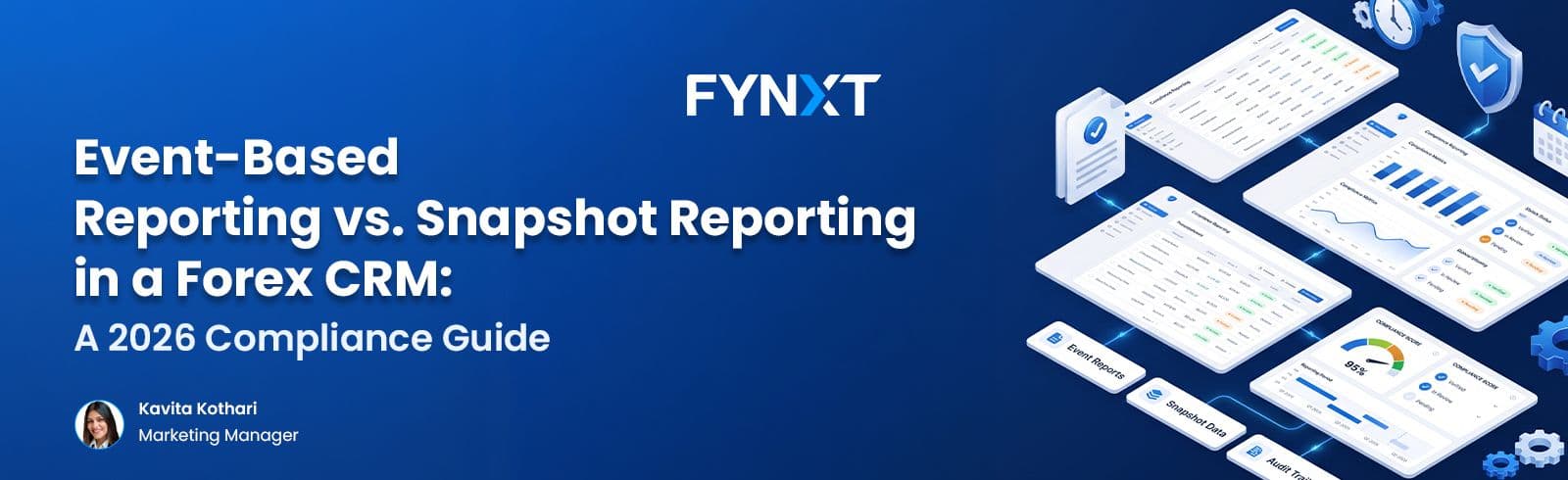
Event-based reporting logs every change to client, trading, and compliance data as a timestamped, attributed record. Snapshot reporting only shows current state, with no trail of who changed what or when. FYNXT's Forex CRM logs activity at the field level, part of the same platform delivering up to 30% operational efficiency gains for brokers.
Short Answer
- Event-based reporting appends a new, timestamped record every time a field changes; snapshot reporting overwrites the old value and shows only the current state.
- MiFID II, ASIC, and CySEC all expect brokers to reconstruct account history on request, not just report where an account stands today.
- Only event logs answer who changed what, from what value, to what value, and when, which is exactly what regulators, dispute teams, and fraud investigators ask.
- FYNXT's Forex CRM logs system activity at the field level as part of its built-in audit trail, with role-based access to every record. Syntellicore, UpTrader, and B2Core do not publicly document the same depth.
Picture the scenario: a regulator asks your compliance head who approved a margin change on a specific client account on March 14 at 2:43 PM, and why. If your CRM only stores current state, you cannot answer that question. You can only describe where the account stands today. If your CRM logs events, you pull the record in seconds.
That gap between “here's the current state” and “here's exactly what happened, and when” is the difference between snapshot reporting and event-based reporting. It is also, increasingly, the difference between passing a regulatory examination cleanly and scrambling to explain a hole in your records.
What is Event-Based Reporting in a Forex CRM?

Event-based reporting is an audit architecture that appends a new, timestamped, attributed record every time a piece of data changes, instead of overwriting the previous value. A margin adjustment, a KYC risk-score update, a commission-tier edit: each becomes its own permanent entry showing what changed, who changed it, the value before and after, and exactly when it happened.
Nothing gets deleted or silently overwritten. The current state is simply the most recent entry in an unbroken chain.
What is Snapshot Reporting, and Why Does it fall short?

Snapshot reporting is an architecture that stores and reports only the current state of a record, overwriting the previous value each time something changes. It works fine for a dashboard that just needs to show today's balance or today's leverage setting.
It fails the moment a compliance officer, a dispute team, or a fraud analyst needs to know what an account looked like at a specific point in the past, because that history was never kept.
| Dimension | Snapshot Reporting | Event-Based Reporting |
|---|---|---|
| What it stores | Current state only | Every state change, in sequence |
| On a data change | Overwrites the previous value | Appends a new record; nothing is deleted |
| Who changed it | Not shown | Captured on every entry |
| Reconstructs the past | No | Yes, field by field |
| Regulatory reconstruction | Fails reconstruction-on-demand tests | Meets reconstruction-on-demand expectations |
| Typical use | Daily dashboards, balance views | Compliance, dispute resolution, fraud review |
Why Regulators Expect Event-Level Audit Trails (MiFID II, ASIC, CySEC)

MiFID II requires investment firms to keep records that let a regulator reconstruct “each key stage of the processing” of a client order, with a minimum five-year retention period that extends to seven years if a regulator asks for it (Sedric, 2025).
One practical diagnostic used in MiFID II compliance reviews: pull three random orders from eighteen months back and reconstruct the complete history across every channel in under one business day. A snapshot-only CRM cannot pass that test, because the intermediate states it would need no longer exist.
ASIC's market integrity obligations in Australia and CySEC's organisational-requirement directives in Cyprus carry the same underlying expectation, even where the wording differs from MiFID II's. Regulators want to see not just where a client account stands today, but how it got there, and who was responsible for each step along the way. A CRM that only reports current state cannot produce that evidence, no matter how accurate today's snapshot is.
Three Broker Pain Points only event logs solve
Client Dispute Resolution
A client disputes a margin call or a commission deduction, and your support team's only defense is today's account state, which does not show what the account looked like at the moment the dispute arose. An event log settles the dispute in one lookup: the exact field, value, actor, and timestamp of the change in question.
Regulatory Examination
An examiner asks for the full history of a specific client relationship, not just its current status. Snapshot-only systems force your compliance team into manual reconstruction from tickets, emails, and spreadsheets. An event-logged CRM produces the same answer as a direct export.
Internal Fraud Investigation
A suspicious pattern surfaces in an IB's commission structure or a dealer's margin overrides, and your risk team needs to know exactly what changed, by whom, and in what order. Event logs give investigators a sequential, attributed record instead of a single static end state that obscures how the account got there.
How FYNXT's Forex CRM Implements Event-Based Logging

FYNXT's Forex CRM answers this by design, not as an add-on. The platform maintains a comprehensive audit trail of all system activity, with field-level master-data change auditing and user navigation tracking built into the core architecture. Every change to client, trading, or compliance data is captured as its own event: the field, the actor, the before value, the after value, and the timestamp.
How FYNXT Compares on Audit Trail Depth
Every major forex CRM markets some version of compliance and record-keeping. The depth each vendor publicly documents, however, varies considerably, and that gap is exactly what shows up when a regulator or a dispute forces the question.
| Provider | What's Publicly Documented | Field-Level Change Logging |
|---|---|---|
| FYNXT | Comprehensive audit trail of all system activity; field-level master-data change auditing; user navigation tracking | Documented |
| B2Core | “Access Controls and Audit Trails” listed under its Operational Safety Platform | Not publicly detailed |
| UpTrader | “Audit-ready reporting” and maintaining accurate transaction records | Not publicly detailed |
| Syntellicore | Proactive risk management, automated account setup, secure data handling | Not publicly detailed |
Documented as of August 2026, based on each vendor's public product pages. “Not publicly detailed” describes what the vendor has published, not a claim that the capability does not exist.
None of this means these platforms lack any logging. It means none currently publishes the level of detail FYNXT documents for its own Forex CRM.
Common Mistakes When Evaluating a Forex CRM's Audit Trail
- Assuming “audit-ready reporting” means field-level logging exists. Ask the vendor to show the actual data model, not the marketing phrase.
- Waiting until a regulator asks before testing reconstruction speed. Pull a specific historical change during vendor due diligence and time how long it takes to produce.
Where This Leaves Your Compliance Team
The practical test is simple: can your CRM answer who changed what, from what value to what value, and when, for any field on any account, on demand? If the honest answer is “only for the current state,” your compliance posture depends on nobody ever asking the harder question. Event-based reporting removes that dependency.
Frequently Asked Questions
Event-based reporting is an audit method that records every change to account, trading, or compliance data as its own timestamped entry, showing the field changed, who changed it, and the value before and after. Nothing is overwritten. FYNXT's Forex CRM uses this method as its default audit architecture.