
- How we Compared Manual and Automated MT4/MT5 Administration
- Which 5 Admin Tasks Change Most Under Automation?
- What Breaks in the Manual Model at Scale?
- The Manual Admin Exposure Model
- What Changes for Audit and Compliance?
- Does Automation Replace Your Ops Team?
- How Does TradeOps Control Center Implement This?
- When is Manual MT4/MT5 Admin Still the Right Call?
- What Does Switching Actually Involve?
- The Bottom Line for Your Ops Lead
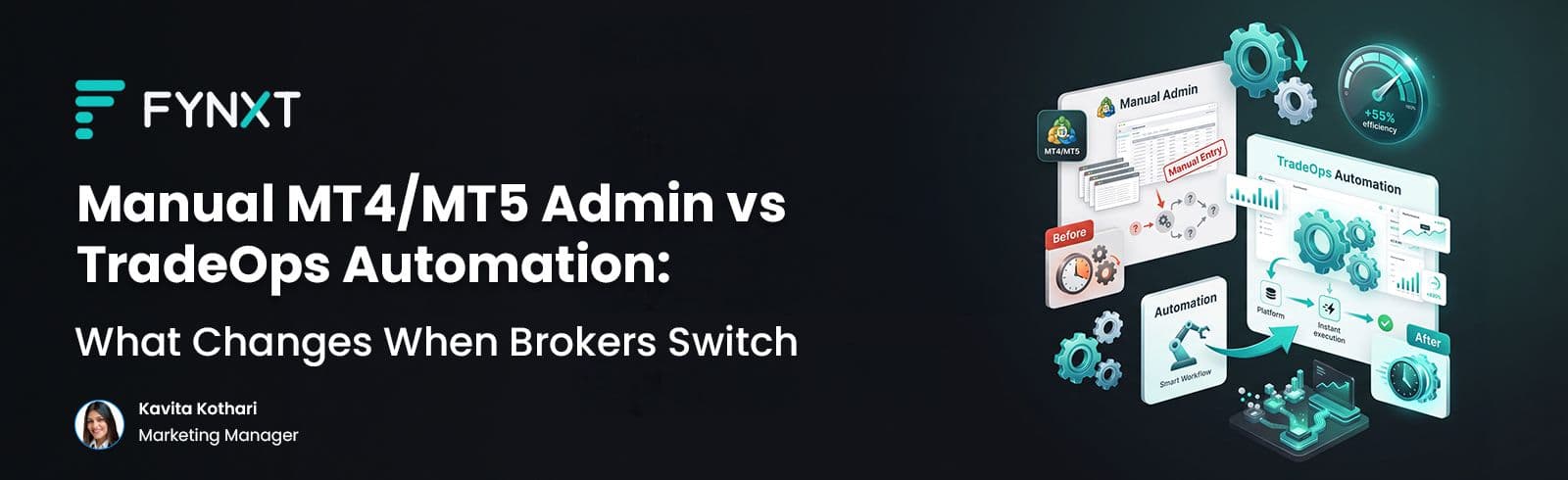
Automating MT4/MT5 administration does not just save time. It changes the failure mode from human error caught late to a validated exception caught immediately. FYNXT TradeOps Control Center reports up to 70% less manual effort on repetitive tasks, and every bulk action carries validation, manager approval, rollback, and an audit trail.
Short Answer: What Changes When You Automate MT4/MT5 Admin?
- The failure mode changes. Manual admin fails silently and gets caught later. Automated admin fails at validation, before execution.
- Five tasks change most: leverage adjustments, swap rate updates, margin and stop-out monitoring, account group migrations, and bulk actions during market events.
- Error exposure scales with volume, not with hours worked. Typing 4,800 swap values a month at a 1% to 2% error rate is 48 to 96 wrong values.
- Audit posture changes more than speed does. Every change gets a before value, an after value, a named approver, and a timestamp.
- The ops team does not disappear. It moves from executing changes to configuring rules and handling exceptions.
- FYNXT TradeOps Control Center reports up to 70% less manual effort on repetitive tasks, with 80% time saved on holiday scheduling.
How we Compared Manual and Automated MT4/MT5 Administration
This comparison uses 5 criteria, stated before the verdicts so you can disagree with the method rather than the conclusion. Each one is something your ops lead can measure next week.
- Time per change set, measured on a realistic batch rather than a single edit.
- Error exposure, measured as entries made by hand multiplied by a realistic error rate.
- Audit evidence, meaning what exists after the change: before value, after value, who, and when.
- Multi-server consistency, meaning whether live, demo, and contest servers end up with the same policy.
- Recovery, meaning how long it takes to undo a wrong change and what state you land in.
Manual versus automated MT4/MT5 administration, at a glance (2026)
| Criterion | Manual native-server admin | Automated bulk administration |
|---|---|---|
| Time per change set | Scales with the number of accounts, symbols, and servers touched | One validated batch regardless of size; FYNXT reports up to 70% less manual effort |
| Error exposure | Every value is typed, so mistakes scale with volume | Pre-execution validation checks symbol existence, group existence, and parameter limits |
| Audit evidence | Whatever the operator remembers to record, often a spreadsheet | Before and after values, user attribution, and timestamps on every field |
| Multi-server consistency | Repeated by hand per server, so drift is normal | One operation applied across selected live, demo, and contest servers |
| Recovery | Manual repair, reconstructed from memory or a partial log | Rollback and atomic transactions, with instant reversion on swap batches |
Which 5 Admin Tasks Change Most Under Automation?
Five tasks account for most of the ops workload on an MT4/MT5 estate, and each one changes in a specific way. The table is the short version. The paragraphs after it cover the two that cost brokers the most when they go wrong.
Before and after: the 5 MT4/MT5 admin tasks that change most
| Admin task | Manual process | Automated process | Risk removed |
|---|---|---|---|
| Leverage adjustments | Per-account edits in the server manager, with no change log by default | Bulk rule-based updates by CSV or UI, validated against parameter limits, every action logged | An account left on the wrong leverage with nobody able to say who changed it |
| Swap rate updates | Entered per symbol per group, under time pressure before rollover | One batch across 600+ symbols and multiple servers, validated for symbol existence and rate anomalies | A mistyped swap charged to every client holding that symbol overnight |
| Margin call and stop-out monitoring | Ops watches dashboards and reacts when somebody notices | Rule-based thresholds and, with the Dynamic Leverage add-on, tier-based adjustment as exposure moves | Exposure that builds faster than a human watching a screen can respond |
| Account group migrations | Ad hoc, undocumented, inconsistent between servers | Templated group updates with compatibility validation and manager approval | Two servers running different trading conditions for the same client segment |
| Bulk actions during market events | The ops team scrambles under deadline on holidays and volatility spikes | Pre-built schedules that apply and then revert automatically once the period ends | A session left open after a holiday, or a change nobody remembered to undo |
Swap updates are the clearest case. A monthly refresh across 600 symbols means 1,200 values per server counting long and short, and most brokers run more than one server. Done by hand, this is a data entry job under deadline pressure, right before rollover.
Session and holiday changes are the sneakiest. The change itself is easy. Remembering to revert it, on every server, after the holiday ends, is what fails. Automated reversion removes the step that depends on somebody remembering.
What Breaks in the Manual Model at Scale?
Manual administration does not degrade gracefully as you grow, because error exposure tracks the number of values typed rather than the hours your team works. That distinction is the whole argument, and it is measurable.
The most-cited research on manual data work comes from Raymond Panko at the University of Hawaii, whose reviews of spreadsheet audits found errors in a large majority of operational spreadsheets, with cell error rates of roughly 1% to 2% in controlled experiments. Ops teams administering a trading server by hand are doing the same kind of work under worse time pressure.
"The most recent field audits, in contrast, generally used better methodologies and found errors in at least 86% of the spreadsheets audited."
- Raymond R. Panko, University of Hawaii, Spreadsheet Errors: What We Know (2008 revision of earlier research)
The Manual Admin Exposure Model
Run your own numbers through this model. Multiply the values your team types each month by the 1% to 2% band, and you get the number of wrong settings you should expect to be carrying at any time. The example below uses a 4-server estate for illustration, not FYNXT measurements.
Manual Admin Exposure Model: illustrative inputs for a 4-server MT4/MT5 estate
| Task | Values typed per month (illustrative) | Expected wrong values at 1% to 2% | What one wrong value costs you |
|---|---|---|---|
| Swap rates (600 symbols, long and short, 4 servers) | 4,800 | 48 to 96 | Every client holding that symbol is charged the wrong overnight rate until someone notices |
| Leverage and group changes (300 accounts) | 300 | 3 to 6 | An account trades at exposure your risk policy never approved |
| Symbol settings (150 changes) | 150 | 2 to 3 | A contract specification differs between your live and demo servers |
| Session and holiday edits (2 events, 4 servers) | 160 | 2 to 3 | A market opens or stays open when your calendar says it should not |
| Monthly total | 5,410 | 54 to 108 | Most are small. The one that is not is the one your regulator asks about |
Two things follow from this. First, hiring another ops person does not fix it, because the new person types at the same error rate. Second, the fix is not carefulness, it is validation before execution plus a second pair of eyes on the batch.
What Changes for Audit and Compliance?
Automation changes your audit posture more than it changes your speed. Native MetaTrader administration was built to give brokers control, not to leave evidence. MetaQuotes describes the broker-side toolset in exactly those terms:
"Brokers retain full control over trading conditions, including margin requirements, contract specifications, credit limits, swaps, trading sessions, spreads, markups, commissions, and other parameters."
- MetaQuotes, MetaTrader 5 for Brokers
Control is not the same as a record. When your compliance head is asked who widened a group's margin requirement 3 months ago and what it was before, control gives you the current value and nothing else. Under MiFID II, firms have to keep records of their services and activities, and platform configuration changes sit inside that scope.
Automated administration closes that gap by default rather than by discipline. Maker-checker approval gives you a named approver. Before and after values with timestamps give you the reconstruction. Role-based access gives you the answer to who could have done it at all.
Want to see a validated bulk update, an approval gate, and a rollback on your own server setup? Book a Demo
Does Automation Replace Your Ops Team?
No, and the teams that resist automation hardest are usually the ones told it will. What actually happens is that the work moves up a level: from executing changes to deciding what the rules should be and reviewing the exceptions the system raises.
The job description shifts in 3 ways. Your ops people spend less time typing and more time reviewing batches before approval. They own policy templates instead of repeating the same edit per server. And they handle the exceptions validation catches, which is a smaller queue than the one where every change is done by hand.
Be honest with the team about this before you switch. The people who know why a group was configured a particular way in 2023 are the same people you need writing the rules afterwards.
How Does TradeOps Control Center Implement This?
FYNXT TradeOps Control Center is a modular MT4/MT5 operations suite that connects to your existing servers and replaces one-at-a-time native admin with validated bulk actions. Every claim below pairs with its safety mechanism, because bulk speed without validation is just a faster way to break a server.
- Accounts Updater. Bulk leverage, group, and password updates by Excel or CSV for unlimited accounts, with pre-flight validation on data integrity, group existence, and parameter limits, plus maker-checker approval and rollback.
- Swaps Updater. Long and short swap rates across 600+ symbols per batch and multiple servers in one operation, with validation for symbol existence and rate anomalies, instant rollback, and exportable change history.
- Groups Updater and Symbols Updater. Batch changes to leverage, margin rates, execution settings, and symbol specifications, synchronised across servers, with compatibility validation before execution.
- Holiday Scheduler. Holiday hours across multiple servers from one interface, with 100% automated reversion once the holiday period ends and 80% time saved against the manual process.
- Session Time Updater. Session changes with timezone handling and scheduled reversion after a set duration, which is where the module's zero manual errors claim applies, and 24/7 multi-timezone coverage.
- Trade Creator, Trade Updater, and Trade Closer. Bulk trade corrections by CSV with preview, before and after state logging, and atomic rollback.
- Server Control Hub and User Access Manager. One interface across live and demo servers, with role-based permissions per brand, team, or department.
Two premium add-ons sit outside the core bundle and are quoted separately. Dynamic Leverage adjusts leverage in real time against exposure, volume, and equity using configurable tiers, and was stress-tested at 100,000+ active accounts and 200k+ positions. The Swap Free Tool handles Sharia-compliant accounts with tier-based duration control and configurable multipliers.
Commercially it is modular per-server pricing with optional premium add-ons, so a single-server broker is not buying the same footprint as a 6-server group. If your wider goal is cutting back-office load rather than MT4/MT5 specifically, the reduce MT4/MT5 ops workload path pairs this with FYNXT Forex CRM, and multi-brand operators usually get there through the White Label Solution.
When is Manual MT4/MT5 Admin Still the Right Call?
Manual administration is still defensible in 3 situations, and pretending otherwise would be a sales pitch rather than an assessment.
- One server, low change volume. If your team touches settings a few times a month on a single server, the exposure model above produces a number close to zero. Automation is a convenience, not a fix.
- Judgment-heavy one-offs. A single client-specific correction after an incident needs a person who understands the context. Bulk tooling helps with the repair, not the decision.
- No external audit pressure yet. An unregulated or pre-launch operation can carry the record-keeping gap for a while. Just be aware that it is a debt, and the bill arrives with your first audit or license application.
The switch usually pays for itself somewhere between the second server and the first time a swap batch goes out wrong. If you are running multi-brand or multi-jurisdiction, you passed that point already.
What Does Switching Actually Involve?
Switching is a connection and a policy exercise, not a platform migration. Your MT4/MT5 servers, liquidity, and client terminals stay where they are.
- Connect the servers. Secure Manager API credentials per server, live and demo.
- Import and template your policy. Guided setup pulls existing groups and symbol settings so you are editing reality, not a blank configuration.
- Set roles and approvals. Decide who prepares batches and who approves them, per brand or team, before anyone uploads a CSV.
- Run a UAT batch. Push a small, reversible change through validation, approval, execution, and rollback so the team sees the full loop.
- Move tasks over in order of pain. Swaps and holiday scheduling first, since they are the highest-volume and most deadline-driven. Trade corrections last.
The Bottom Line for Your Ops Lead
The time saving is the headline, and it is real: up to 70% less manual effort on repetitive tasks. The durable change is that mistakes stop being discoveries and start being rejections at validation.
Price the switch against the exposure model, not against the hours. A broker carrying 54 to 108 wrong values a month is not paying for a tool, they are paying to stop finding out about them from clients.
Frequently Asked Questions
MT4/MT5 account administration automation replaces one-at-a-time changes on the native server console with validated bulk operations: leverage and group updates, balance adjustments, symbol and swap changes, session and holiday scheduling. In FYNXT TradeOps Control Center, each batch is validated before execution, approved by a manager, logged with before and after values, and reversible.