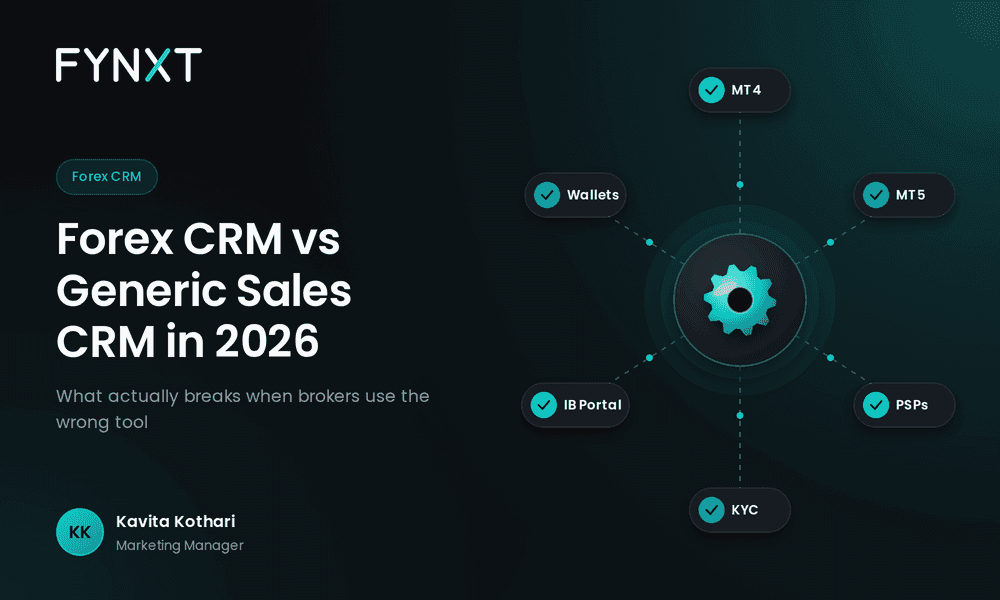

- Forex CRM vs Salesforce and HubSpot at a Glance
- Why Does Trading Account Sync Break in a Generic CRM?
- Why Do IB Hierarchies and Commissions Break?
- Why Does KYC and Onboarding Break?
- Why do Deposits and Withdrawals Break?
- Why Do Audit Trail and Access Control Break?
- When is a Generic CRM Good Enough?
- How do you run a Sales CRM alongside a Forex CRM?
- Common Mistakes When Choosing Between the Two
A generic sales CRM such as Salesforce or HubSpot has no native concept of a trading account, an IB tree, or a regulated onboarding flow, so brokers rebuild all three with custom work. A forex CRM ships them. FYNXT Forex CRM goes live in 10 to 14 days and improves operational efficiency by up to 30%.
Short Answer
- Verdict. If you run trading accounts, an IB program, or regulated onboarding, a forex CRM wins. If you only need a sales pipeline, a generic CRM is fine.
- What breaks. Trading account sync, IB commissions, KYC, payments, and audit trail.
- What it costs. Salesforce Financial Services Cloud lists at $325 to $700 per user per month before any trading integration.
Forex CRM vs Salesforce and HubSpot at a Glance
This table compares out-of-the-box capability with the custom work needed to close each gap, using vendor pages as of October 2026.
| Capability | Salesforce / HubSpot out of the box | Custom work needed | FYNXT Forex CRM |
|---|---|---|---|
| Trading account sync | No trading account object | Middleware on MT4/MT5 Manager API, custom objects | Native MT4, MT5, cTrader, DXtrade, Sirix, proprietary |
| IB hierarchy and commissions | Account hierarchies, no per-trade commission logic | Commission engine, partner portal | Multi-level IB, commission per level, partner portal |
| KYC and onboarding | Forms and workflows, no appropriateness tests | KYC vendor apps, custom flows per jurisdiction | Sumsub, Shufti Pro, GBG; retail, joint, corporate, institutional |
| Deposits and withdrawals | No PSP or wallet logic | PSP integrations, reconciliation | 30+ PSPs incl. Praxis, Match2Pay, BridgerPay |
| Audit trail | Salesforce: 20 fields per object, 18 months (60 with Field Audit Trail) | Add-on licenses, logging of trading-side events | Field-level change auditing, user navigation tracking |
| List price | Salesforce FSC $325 to $700/user/mo; HubSpot Sales Hub Enterprise $150/seat/mo | Plus build and maintenance | Not publicly disclosed |
| Go-live | Depends on build scope | Months for a full broker build (not benchmarked) | 10 to 14 days |
The criteria are the five workflows that break first when a broker grows, in the order they usually break.
Why Does Trading Account Sync Break in a Generic CRM?
Trading account sync breaks because a generic CRM has no object for a trading account, its balance, or its open positions. Your sales team sees a contact, not a trader.
Symptom. Retention calls go to clients who withdrew yesterday.
Workaround. A nightly CSV export from the trading server, or middleware built on the MetaTrader 5 Manager API, which MetaQuotes describes as a way to “develop custom administration and management utilities.”
Cost. A developer owns that middleware forever, and every platform update is a regression test.
FYNXT Forex CRM integrates natively with MT4, MT5, cTrader, DXtrade, Sirix, and proprietary platforms and supports multiple trading accounts per client in one view. Server-side admin work sits in TradeOps Control Center.
Why Do IB Hierarchies and Commissions Break?
IB hierarchies break because generic CRMs model who owns an account, not who earns on each trade it places. Parent-child accounts are not a commission tree.
Symptom. Month-end commissions are rebuilt in spreadsheets and partners dispute them.
Workaround. A custom commission engine plus a separate partner portal.
Cost. Every rule change, a new tier or a spread rebate, is a development ticket.
FYNXT Forex CRM supports multi-level IB structures with flexible commission at each level, a partner portal, tracking links, and e-signed agreements. FYNXT’s IB Manager has freed up $450K+ in IB rebates in 20 days.
Why Does KYC and Onboarding Break?
KYC breaks because regulated onboarding is more than a form. It needs document checks, appropriateness tests, risk scoring, and an approval path that differs by entity and jurisdiction.
Symptom. Your back office chases KYC status by email.
Workaround. Third-party KYC apps stitched to custom flows.
Cost. Each new jurisdiction means rebuilding the flow.
FYNXT Forex CRM configures onboarding for retail, joint, corporate, and institutional accounts, with appropriateness tests, risk scoring, approval routing with SLAs, and role-based decision logging. KYC providers include Sumsub, Shufti Pro, and GBG.
“Most CRMs promise the world and collapse the moment you introduce real-world brokerage workflows. But FYNXT held up.”
Sarah Richardson, Head of Business Development, Dubai-based broker
Why do Deposits and Withdrawals Break?
Payments break because a generic CRM has no idea what a PSP callback, a pending withdrawal, or a crypto deposit is. Finance ends up working outside the CRM.
Symptom. Clients ask where their deposit is and support cannot see it.
Workaround. PSP dashboards checked by hand, then reconciled.
Cost. Slow funding stalls a new client before the first trade.
FYNXT Forex CRM connects to 30+ PSPs, including Praxis, Match2Pay, and BridgerPay, covering bank transfer, card, and crypto, with automated deposit confirmations.
| Bring your hardest workflow to the demo. Book a Demo and see an IB payout or a corporate KYC case run end to end. |
Why Do Audit Trail and Access Control Break?
Audit trails break because the events regulators ask about happen outside a generic CRM: balance adjustments, IB reassignments, and trading account changes. The CRM logs what it can see.
Salesforce tracks history on up to 20 fields per object for 18 months by default, rising to 60 fields with its Field Audit Trail add-on, and its role controls are strong. The gap is coverage, not quality. FYNXT Forex CRM logs all system activity with field-level master-data change auditing, user navigation tracking, and access set at module, page, and operation level. For what regulators expect, see our guide to Forex CRM audit trail features.
When is a Generic CRM Good Enough?
A generic CRM is fine when the trading side is simple. Choose Salesforce or HubSpot if:
- You are pre-launch or very early, with no IB program yet.
- You run one trading platform and a back office that already handles KYC and payments.
- You only need marketing automation and a sales pipeline on top of an existing system.
Choose FYNXT Forex CRM if you run IBs, more than one platform, or onboarding across jurisdictions, or if your reports depend on trading data. Forex-native rivals such as UpTrader and Syntellicore are worth testing against the same five points.
How do you run a Sales CRM alongside a Forex CRM?
You run both by giving every record exactly one owner and naming the integration points before you start. Use this record ownership map as your starting point.
| Record | System of record | Sync rule |
|---|---|---|
| Marketing lead, campaign touch | Sales CRM | Push to forex CRM at registration |
| Client profile and KYC status | Forex CRM | Read-only status back to sales CRM |
| Trading accounts and balances | Trading platform via forex CRM | Never edited in the sales CRM |
| Deposits and withdrawals | Forex CRM | Summary totals only to sales CRM |
| IB tree and commissions | Forex CRM | Not synced; partners use the partner portal |
Two owners for one record is how duplicate clients and broken attribution start. Our lead loss guide shows where handoffs leak, and event-based reporting covers the reports that depend on clean ownership.
Common Mistakes When Choosing Between the Two
- Pricing seats, not the build. A 20-person team on Salesforce Financial Services Cloud Sales Core is $78,000 a year at list price, before any trading integration.
- Letting both systems edit client data. Pick one owner per record.
- Testing with demo data. Run a real IB payout and a corporate KYC case in every evaluation.
Frequently Asked Questions
Yes, but only after custom work. Salesforce has strong sales, service, and access controls, yet no native trading account, IB commission engine, or regulated onboarding flow, so you build those with middleware and custom objects. FYNXT Forex CRM ships them natively and goes live in 10 to 14 days, which suits brokers who would rather configure than build.