
- What Does Lead Loss Actually Look Like?
- What are the 5 Ways Forex Brokers Lose Leads?
- Why is Forex Lead Conversion Unusually Time-Sensitive?
- The Lead Leak Audit: 5 Tests to Run This Week
- What Does Automated Lead Routing Look Like in Practice?
- The Follow-Up Cadence That Catches What the First Call Misses
- How Does FYNXT Forex CRM Close the Gap?
- How Do Other Forex CRMs Handle Lead Loss?
- Mistakes That Keep Leads Leaking After You Buy a CRM
- The Bottom Line for Your Head of Sales
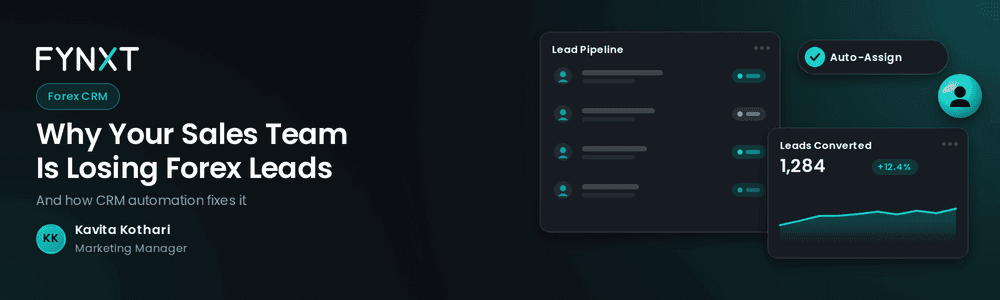
Forex brokers lose leads in the gap between form submission and first contact. Harvard Business Review research found firms that make contact within an hour are nearly 7 times more likely to qualify a lead. FYNXT Forex CRM closes that gap with lead segmentation, source tracking, and triggered follow-up on KYC and deposit events.
Short Answer: Where Do Forex Leads Actually Go?
- They leak between form submission and first contact. Speed is the variable, not pitch quality.
- Five leaks account for most of it: no automated routing, no follow-up triggers, disconnected KYC and CRM, no lead scoring, and marketing data that never reaches the agent.
- Response-time research is blunt: contact within an hour is worth nearly 7 times the qualification odds of contacting an hour later, and more than 60 times the odds of waiting a day.
- Forex makes it worse. Your lead is comparing 3 to 5 brokers at once and the switching cost between them is close to zero.
- The fix is event-driven, not motivational. Route by rule, trigger the next touch when nothing happens, and tie follow-up to KYC and deposit events.
- FYNXT Forex CRM keeps client, KYC, payment, and IB data in one record and reports up to a 30% improvement in operational efficiency.
What Does Lead Loss Actually Look Like?
Lead loss looks like a lead that arrives at 09:12, sits in a shared inbox until someone opens it at 15:40, and gets a call the next morning from an agent who has no idea which campaign brought them in. Nothing visibly broke. The pipeline report still counts the lead.
The research on this is old, large, and uncomfortable. A study published in Harvard Business Review audited 2,241 US companies and analysed 1.25 million leads across 42 firms.
"37% responded to their lead within an hour, and 16% responded within one to 24 hours, 24% took more than 24 hours, and 23% of the companies never responded at all."
- Oldroyd, McElheran, and Elkington, The Short Life of Online Sales Leads, Harvard Business Review (2011)
The same research found that firms contacting a prospect within an hour were nearly 7 times more likely to qualify the lead than firms that waited just one hour longer, and more than 60 times more likely than those that waited 24 hours or more. Your dealing desk would never accept a 60x execution penalty. Your sales funnel accepts one every day.
What are the 5 Ways Forex Brokers Lose Leads?
Five leaks account for most lost forex leads, and each one has a visible symptom your sales manager can check today. The fix column is the automation that closes it.
The 5 lead leaks in a forex brokerage: cause, symptom, and fix
| Cause | The symptom you can see | The automation that fixes it |
|---|---|---|
| No automated routing | Leads sit in a shared inbox or a queue until an agent claims one | Rule-based assignment on submission, by region, language, campaign source, or stated deposit size |
| No follow-up triggers | One call, no answer, no scheduled second touch | A cadence that fires automatically when no human contact is logged |
| Disconnected KYC and CRM | The client finishes verification and nobody on the sales side is told | Triggered alerts on KYC status changes and deposit confirmations |
| No lead scoring | A $50,000 prospect and a curiosity form-fill get identical treatment | Scoring on deposit size, KYC completion speed, and source, surfaced in the agent queue |
| Marketing and sales data silos | The agent opens the call with a generic script because the campaign is invisible | Lead-source tracking carried into the client record and the agent view |
The third leak is the one brokers underestimate. A trader who has just uploaded a passport is at their highest intent of the entire journey, and if the next thing they hear is nothing for 2 days, the intent decays. That handoff is an event, and events are what automation is good at.
Why is Forex Lead Conversion Unusually Time-Sensitive?
Forex lead conversion is more time-sensitive than most B2C verticals because your prospect is almost certainly filling in 3 to 5 broker forms in the same session. They are not evaluating you against nothing. They are evaluating you against whoever calls first.
Switching cost at that moment is near zero. No funds have moved, no positions exist, and every broker on the shortlist offers the same platform. The first broker to make contact gets to frame the comparison, and the rest are answering objections created by somebody else.
There is a second clock too. The regulated journey from interest to funded account runs through KYC, and every silent gap in that sequence is an exit point where a competitor who is already calling looks easier.
The Lead Leak Audit: 5 Tests to Run This Week
Run this audit before you buy anything. Each test uses data your current system already holds, and each one produces a number you can put in front of your management team.
Lead Leak Audit (FYNXT, 2026): 5 diagnostic tests for a brokerage sales funnel
| Leak | The test to run | The number to pull | What good looks like |
|---|---|---|---|
| Routing delay | Take last month's leads and measure submission timestamp to first outbound contact | Median minutes to first contact, and the 90th percentile | Median inside 5 minutes; nothing waiting over an hour |
| Follow-up drop-off | Count leads with exactly 1 logged contact attempt and no outcome | Percentage of leads with a single touch | Under 10%, because the cadence is automated, not optional |
| KYC to funding gap | Measure time from KYC approval to first deposit, and to the first sales contact after approval | Median hours from approval to contact | Contact inside the same hour as approval |
| Scoring blindness | Sort last quarter's funded clients by deposit size, then check how fast each was contacted | Response time for your top 10% of deposits | Your best prospects are contacted first, not last |
| Source blindness | Pick 20 recent leads and ask the assigned agent which campaign brought each one in | Percentage the agent can answer correctly | Above 90%, because it is on the record, not in a report |
Two of these usually produce an unpleasant surprise. The 90th percentile response time is normally hours worse than the median, and the single-touch percentage is normally double what the sales manager guessed.
What Does Automated Lead Routing Look Like in Practice?
Automated lead routing assigns the lead to a named agent within seconds of submission, using attributes you already collect. The common routing dimensions are region and language, campaign source, stated deposit size, and account type, with a fallback rule so nothing lands nowhere when an agent is offline.
Routing only works if it comes with a clock. Give each tier an SLA, put the timer on the lead record, and escalate to a team lead when it expires. A routing rule with no deadline just moves the queue.
The Follow-Up Cadence That Catches What the First Call Misses
A follow-up cadence fires automatically when no human contact has been logged, which is what makes it survive a busy Tuesday. Change channel at each step so the sequence does not read as one agent calling 4 times.
A default forex lead cadence, with the trigger that fires each step
| Step | Timing | Channel | Trigger that fires it |
|---|---|---|---|
| 1 | Within 5 minutes | Call | Lead submission, routed and assigned |
| 2 | Within 1 hour | Email with the platform and funding detail | No connected call logged on step 1 |
| 3 | Day 1 | Call at a different hour of the day | No reply logged on step 2 |
| 4 | Day 3 | SMS or messaging app, short and specific | No reply logged on step 3 |
| Event | On KYC approval or rejection, and on first deposit attempt | Call plus automated status message | KYC status change or deposit event on the client record |
The event row matters more than the timed ones. A lead who completes KYC has told you they intend to fund, and a broker who responds to that signal within the hour is having a different conversation than one working through a day-3 list.
Want to see routing rules, SLA timers, and KYC-triggered follow-up running on one client record? Book a Demo
How Does FYNXT Forex CRM Close the Gap?
FYNXT Forex CRM closes the gap by keeping the events that drive follow-up in the same record as the client. Lead segmentation, lead-source tracking, and pipeline monitoring sit alongside KYC status, payments, and IB attribution, so the agent working the lead can see why it arrived and what has happened since.
- Triggered communications on the events that matter. Automated messages fire on account activity, KYC status, and deposit confirmations, which is exactly where the third leak opens.
- Segment-based campaigns with next-step logic. The following action is executed based on how the audience responds, so a non-reply is a state the system acts on rather than a gap somebody notices later.
- Lead-source tracking through to the client record. The campaign that produced the lead stays attached to it, so the opening line is specific.
- Pipeline monitoring and RM, sales, and executive dashboards. Bottlenecks surface as a view rather than as a quarterly discovery.
- KYC and AML automation with risk scoring. Document processing, identity verification, and risk scoring run inside Digital Onboarding, with approval routing, SLAs, and role-based decision logging.
- Communication integrations. Email sync and tracking, SMS, and VoIP integrations, so contact attempts are logged against the record rather than living in an agent's phone.
The operational case is the 30% figure. FYNXT reports up to a 30% improvement in operational efficiency for brokers on the platform, and go-live in 10 to 14 days, as little as 7 for simple setups. A lead-loss fix that takes 2 quarters to deploy is 2 quarters of leaks you keep paying for, which is why deployment time belongs in this conversation at all. FYNXT was named Best CRM Provider at the Finance Magnates London Summit 2025.
Two adjacent pieces matter for lead flow. Automating client onboarding removes the dead air between interest and funding, and partner-sourced leads arrive with attribution intact when IB Manager is part of the same record, so nobody argues later about whose lead it was.
How Do Other Forex CRMs Handle Lead Loss?
Most forex CRMs now claim some lead automation, and the honest position is that several do it well. What follows is drawn from each vendor's own public pages in September 2026, so treat it as what they say rather than as tested capability.
What the main forex CRMs publish about lead handling
| Platform | What it publishes on lead handling | Where it fits |
|---|---|---|
| FYNXT Forex CRM | Lead segmentation, lead-source tracking, pipeline monitoring, triggered communications on KYC and deposit events, campaign next-step logic, VoIP and email integrations, 10 to 14 day go-live | Brokers who want the lead, KYC, payment, and IB record in one system rather than stitched together |
| Syntellicore | States that every source is "routed, de-duplicated and assigned before a human touches it", with real-time explainable scoring, behavioural triggers across email, SMS, and portal, and a published +27% first-time deposits figure from AI-prioritised leads | Sales-led brokerages that want scoring and triggers as the centre of the workflow |
| AltimaCRM | Lead scoring, automated sequences, and VoIP-integrated calling, with a claim of 1.2 million leads managed across deployments | Call-centre-heavy sales floors where dial volume is the operating model |
| UpTrader | Rule-based assignment by region, deposit size, or manager hierarchy, plus deposit-attempt and task tracking in one interface | Teams whose main gap is assignment rather than scoring; public detail on follow-up automation is thinner |
| FX Back Office | Lead and client follow-up system, lead status allocation, VoIP calling with automatic call recording, and over 60 automated emails tied to client actions | Brokers who want email automation and call recording out of the box |
| Leverate | Automation, behavioural triggers, and client segmentation to move leads through the funnel, with built-in VoIP and messaging and a single metrics view | Brokers already standardised on the wider Leverate ecosystem |
The pattern worth noticing is what nobody publishes: a response-time number. Every vendor in this table, FYNXT included, describes capability rather than outcome. Ask each one what median time to first contact looks like on a live deployment, and treat a straight answer as a differentiator.
Mistakes That Keep Leads Leaking After You Buy a CRM
- Buying routing without a timer. Assignment with no SLA moves the queue from the inbox to an individual agent, where it is harder to see.
- Automating the first touch only. The first call is the easy one. Leads are lost on the second and third that nobody scheduled.
- Scoring on demographics instead of behaviour. KYC completion speed and deposit attempts predict funding better than job title ever will.
- Leaving KYC on a separate system. If the verification event does not reach the CRM, your best-timed contact opportunity never fires.
- Measuring dials instead of response time. A team can make 200 calls a day and still take 6 hours to reach a new lead.
- Treating partner-sourced leads differently. IB-introduced clients deserve the same clock; attribution disputes usually start as follow-up delays.
The Bottom Line for Your Head of Sales
Lead loss is a timing problem wearing a conversion problem's clothes. The pitch is rarely what failed. The 6 hours before anyone dialled is what failed.
Run the 5 audit tests, put a clock on every routed lead, and make KYC approval a trigger rather than a status somebody checks. Then measure the one number no vendor publishes: your own median minutes to first contact.
Frequently Asked Questions
Forex brokers lose leads to delay and silence rather than to price. A lead sits unassigned in a shared inbox, nobody schedules a second touch, and the trader funds an account with whichever broker called first. Research published in Harvard Business Review found 23% of audited companies never responded to an inbound lead at all.