The Complete Guide to IB Management Software for Forex Brokers (2026)
Share this article
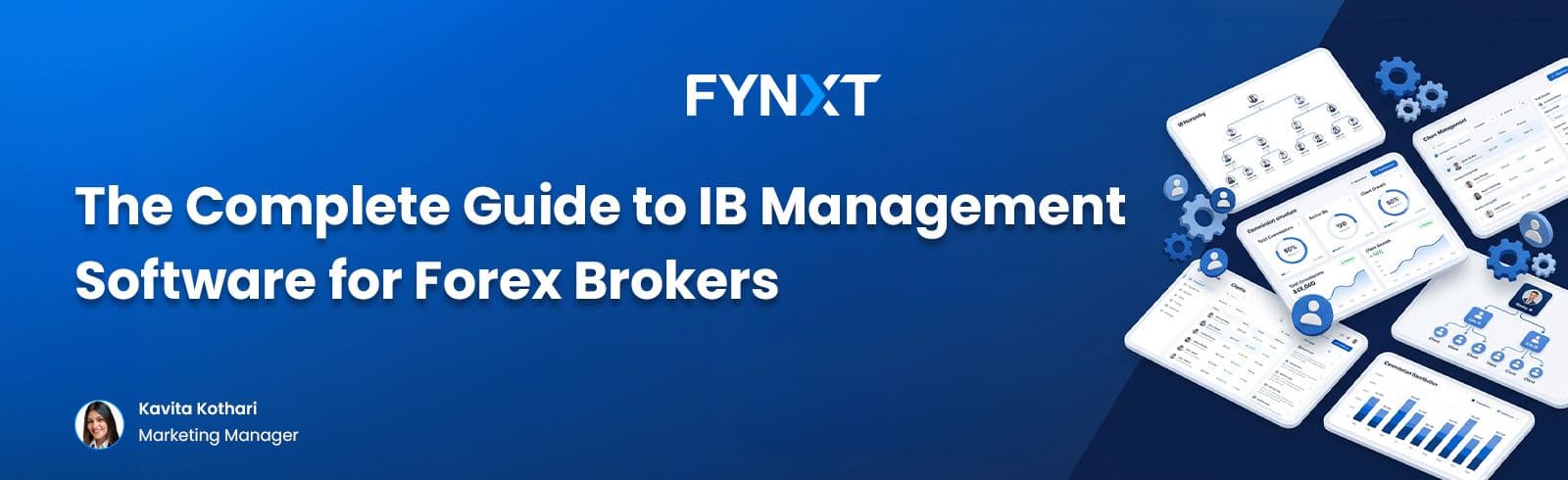
IB management software automates multi-tier commission calculation, partner portals, and rebate payouts for forex brokers running introducing-broker networks. FYNXT's IB Manager supports unlimited N-level hierarchies and unlocked $450K+ in previously undiscovered IB rebates within 20 days for one broker. This guide covers commission structures, must-have features, and how to evaluate vendors.
Key Takeaways
- IB management software automates commission calculation across multi-tier partner hierarchies, replacing spreadsheets that break down past a handful of partners.
- A Master IB, Sub-IB, and Affiliate are three different partner types, and cascading commission structures pay each of them differently on the same trade.
- FYNXT's IB Manager runs unlimited N-level hierarchies, 8+ pre-defined rebate scheme types, and automated fraud checks before a rebate becomes withdrawable.
- IB mapping and reassignment changes reflect within about an hour, not at month-end. FYNXT's IB Manager updates within 60 minutes with full audit logs.
- FYNXT's IB Manager deploys either as a standalone module integrated into your existing CRM and trading stack, or natively inside FYNXT's Forex CRM. Exinity took the standalone path and was live in under two weeks.
- When you evaluate vendors, weigh hierarchy depth, commission-model flexibility, reconciliation tooling, and native MT4/MT5 integration. Price alone won't tell you much.
Why IB Networks Are Your Brokerage's Most Efficient Growth Channel
Introducing brokers are the growth channel your brokerage most likely already has and most likely under-manages. A single IB can bring in dozens of active clients that your marketing budget would otherwise spend thousands acquiring one at a time.
How Much Revenue Actually Comes Through IBs
Industry estimates place IB-driven client acquisition at 40–60% of retail forex broker volume, though the exact share will vary for your brokerage depending on region and asset class. What stays consistent across brokerages of every size is the pattern: once your IB network exists, it compounds. A Master IB who recruits Sub-IBs isn't adding one partner to your books. They're adding a distribution layer.
Cost Per Acquisition Through IBs vs. Direct Marketing
Direct paid acquisition in forex runs your client acquisition cost into the hundreds of dollars per funded account, paid whether or not that client stays active. That money is spent the moment the ad is clicked, win or lose. IB-sourced clients invert that economics for you: you pay a rebate only on realized trading activity, not on the acquisition attempt itself.
The Types of Introducing Partners You'll Manage
Your brokerage will typically manage three overlapping partner types, and your IB management software needs to handle all three without forcing you to pick one:
- IB (Introducing Broker): refers clients directly and earns a share of the spread, commission, or a flat rebate per lot traded.
- Sub-IB: recruited by a Master IB, refers their own clients, and typically earns a lower base rate. The Master IB earns an override on the Sub-IB's client volume.
- Master IB: manages a network of Sub-IBs, earns on direct clients plus overrides across every tier beneath them.
- Affiliate: usually paid CPA (cost per acquisition) rather than ongoing revenue share, and doesn't build a sub-network the way an IB does.
Regulatory terminology varies by jurisdiction, and this matters for what you call the relationship in your own paperwork: under the UK's onshored MiFID II framework, the closest formal category to an IB is a "tied agent," registered with the FCA and operating under your firm's full responsibility (LexisNexis, 2026). If you're US-regulated, you instead register IBs directly with the NFA/CFTC. Your IB management software should track partner type and jurisdiction separately, since compliance obligations differ even when the commercial commission mechanics look identical.
What Is IB Management Software?
IB management software is the system that automates commission calculation, partner onboarding, and payout across your network of introducing brokers, sub-IBs, and affiliates. It replaces manual, spreadsheet-based rebate tracking with rules-based, auditable calculation tied directly to trading activity. No more chasing a spreadsheet at month-end to find out who's owed what.
Where It Sits in Your Tech Stack
IB management sits between your CRM, your trading server, and your payment layer, whether you run it as a standalone module or as part of a full CRM. It needs live trade data from MT4, MT5, or cTrader to calculate commissions, client data to attribute trades to the correct partner, and a settlement path to actually pay the IB. FYNXT's IB Manager is available either way: as a standalone module you integrate into your existing CRM and trading stack, or natively inside FYNXT's Forex CRM, where your partner records, KYC data, and commission history live in one CRM record instead of two systems you have to reconcile against each other.
How It Differs From a Generic CRM or Standalone Affiliate Platform
A generic CRM like Salesforce or HubSpot has no concept of a lot, a spread, or a trading server. It can log that a referral happened, but it can't tell you what it's worth without custom development. A standalone affiliate platform tracks clicks and conversions well but usually has no native connection to your MT4/MT5 trade data, so your commission calculation still runs on a manual export.
Native IB Management vs. Standalone Affiliate Software
The practical difference shows up at reconciliation time. Native IB management inside your CRM can recalculate historical commissions when you reassign a client between partners, because it owns both the trade data and the partner hierarchy in one system. Standalone affiliate software generally can't do this without a manual data pull, because your trading data lives somewhere else entirely.
How Do Multi-Tier Commission Structures Work?
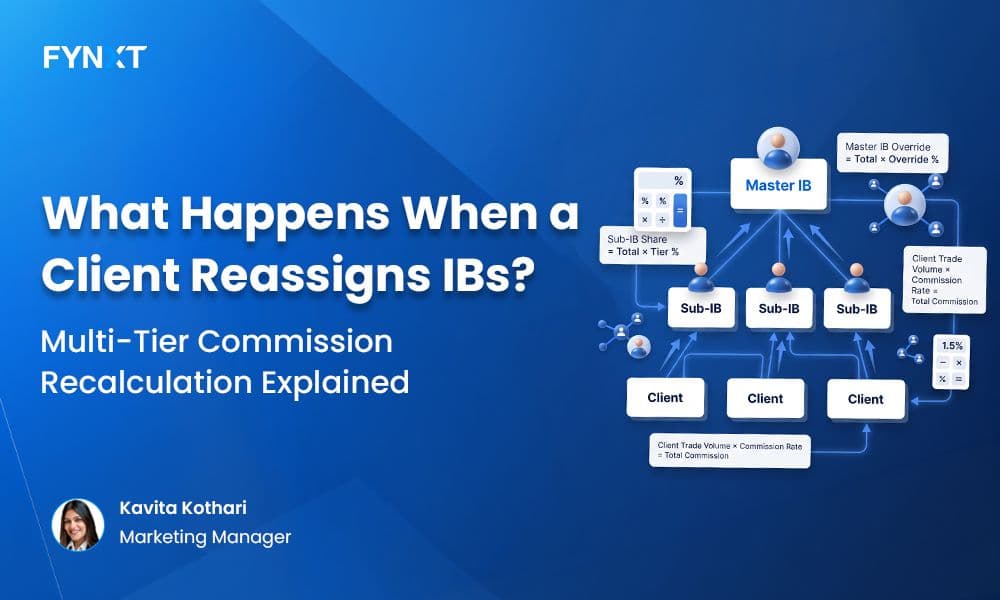
Multi-tier commission structures pay more than one partner on the same underlying trade: the referring partner earns a direct rate, and every partner above them in your hierarchy earns an override on that same volume, calculated independently and simultaneously.
Flat-Rate vs. Per-Lot vs. Revenue-Share Models
Three base models cover most brokerage commission structures.
- Flat-rate pays a fixed dollar amount per referred, funded client, regardless of how much they trade.
- Per-lot (dollars-per-lot) pays a fixed amount for every standard lot traded by the referred client, rewarding volume over time rather than a one-time signup.
- Revenue share pays a percentage of the spread or commission you earn from the client's trading, which scales with both volume and pricing.
Most brokerages don't pick just one. FYNXT's IB Manager supports all three for you, plus spread-percentage and markup-percentage models, combinable in a single structure with 8+ pre-defined scheme types.
Worked Example: Master IB → Sub-IB → Affiliate Cascading Commissions
The table below is an illustrative worked example of how a three-tier, per-lot structure cascades through FYNXT's IB Manager. It isn't a specific client's real figures. It demonstrates the mechanism using representative rates and volumes so you can see how the math actually flows.
Structure: the Master IB earns a direct rate on their own clients, plus a first-level override on their Sub-IB's client volume, plus a smaller second-level override on volume sourced by the Sub-IB's downstream Affiliate.
| Tier | Role | Own Direct Rate | Override Rate(s) | Monthly Volume (Own Clients) | Commission Earned |
|---|---|---|---|---|---|
| 1 | Master IB | $7.00/lot | $1.50/lot (Sub-IB override) + $0.50/lot (2nd-level Affiliate override) | 600 lots | $4,200 direct + $375 + $200 override = $4,775 |
| 2 | Sub-IB | $5.00/lot | $1.00/lot (Affiliate override) | 250 lots | $1,250 direct + $400 override = $1,650 |
| 3 | Affiliate | $3.50/lot | None | 400 lots | $1,400 direct |
| Total | 1,250 lots | $7,825 |
Read across the tiers and the mechanism becomes clear: a single trade generates commission at every level of your hierarchy simultaneously, each calculated at a different rate, each configured independently in FYNXT's no-code rebate builder. Under this illustrative structure, 1,250 total lots traded across the network in one month generate $7,825 in combined partner payouts, split three ways by tier. The Master IB earns both a direct rate and two separate override rates on the same monthly volume pool.
Volume Tier Upgrades and Automated Recalculation
Commission rates commonly step up at volume thresholds. A Sub-IB might move from a lower per-lot rate to a higher one after crossing a monthly volume milestone. Calculating that by hand across dozens of partners, each with a different threshold, is where your spreadsheet-based rebate tracking breaks down. FYNXT's IB Manager recalculates using historical trade data when a rate, tier, or partner assignment changes, and reflects mapping changes within 60 minutes, with notification and a full audit log of what changed and when.
What Features Should You Look For in IB Management Software?
Seven capabilities separate production-ready IB management software from a partner-tracking spreadsheet with a login page bolted on:
- Multi-tier commission engine that supports unlimited hierarchy depth, not a fixed 2- or 3-level cap.
- Real-time partner dashboard showing clicks, new clients, conversions, and payouts, not a monthly PDF statement.
- Automated rebate processing that settles on a schedule without a finance team manually approving every line. Manual approval doesn't scale past a handful of partners.
- Sub-IB hierarchy support with independent commission structures at every level, configurable without a developer.
- Referral link tracking and attribution with region-specific, encrypted links, so you can tell which link, country, or campaign actually sourced a client.
- Native trading-platform integration with MT4, MT5, and ideally cTrader, so your commission calculation runs on live trade data instead of a manual export.
- Compliance-ready audit trails: every commission change, reassignment, and payout logged with a timestamp and user attribution, ready for your regulator or internal auditor to review.
Feature Comparison: Top IB Management Systems in 2026
The table below compares FYNXT's IB Manager against four platforms you'll likely shortlist for IB management, based on each vendor's published capabilities and third-party reporting as of mid-2026. Deployment-time figures for competitors are reported industry estimates, not independently verified by FYNXT.
| Platform | Max Hierarchy Depth | Commission Models | Native MT4/MT5 | Real-Time Partner Dashboard | Typical Deployment Time |
|---|---|---|---|---|---|
| FYNXT IB Manager | Unlimited N-level | Per-lot, spread %, commission %, markup %, 8+ pre-defined scheme types | Yes, plus cTrader | Yes, 7 live KPIs incl. AI churn prediction | < 2 weeks standalone (verified: Exinity, 2025); 10–14 days bundled with Forex CRM |
| Brokeret | Multi-tier (depth not publicly specified) | Multi-tier commission structures | Yes | Yes | Not independently verified |
| UpTrader | Multi-level | CPA, revenue share, hybrid | Yes | Yes | 4–8 weeks (reported) |
| Syntellicore (RebateCore) | Unlimited tiers (vendor-stated) | Multi-scheme, multi-campaign | Yes | Yes | 4–8 weeks (reported) |
| B2Core | Up to 30 levels (reported); "unlimited-depth" per vendor | CPA, revenue share | Yes | Yes | 4–8 weeks, often longer for enterprise scope (reported) |
How Does FYNXT's IB Manager Handle Complex Commission Hierarchies?
FYNXT's IB Manager builds your unlimited N-level hierarchies through a no-code, template-driven configuration. Your operations team, not a developer, sets up and edits commission rules.
Setting Up Your Partner Hierarchy
You configure Master IBs, Sub-IBs, and Affiliates as distinct partner records, each linked to the parent partner above them. Because the hierarchy has no depth limit, a Master IB on your books can recruit Sub-IBs who recruit their own Sub-IBs, and every level calculates independently.
Configuring Commission Rules Per Symbol or Group
Rebate/fee structures apply to both trading accounts and managed accounts, and you can set rates at the symbol or group level. You can pay a different per-lot rate on major FX pairs than on indices or crypto CFDs, with FYNXT's symbol-level performance fixes and RegExp-based symbol group mapping handling the underlying MT4/MT5 group changes automatically.
Reconciliation: Recalculation, Reassignment, and Error Correction
This is the part most competing systems handle poorly. When you reassign a client from one IB to another, a common event when partners leave or accounts get restructured, FYNXT's IB Manager recalculates historical commissions against the new hierarchy, corrects the error, and logs the change, rather than requiring your finance team to recalculate manually. Automated compliance checks run before a rebate becomes available for IB withdrawal, and rules are designed to stop spam or fraudulent referrals before payout rather than clawing them back after.
Verified client outcomes: a Cyprus-based broker saw a 45% increase in IB network size and a 60% increase in client acquisition through IBs after implementing FYNXT's IB Manager; an East Asia-based broker saw a 35% improvement in conversion rates; and one broker unlocked $450K+ in previously undiscovered IB rebates within 20 days of deployment.
Real-World Example: Exinity's Zero-Downtime IB Migration
Exinity is the global multi-brand trading group behind FXTM, NEMO, and Connect. It needed to overhaul its Introducing Broker infrastructure while scaling an international IB network across multiple jurisdictions, without disrupting a live business. FYNXT's IB Manager was integrated directly into Exinity's existing tech stack as a standalone module, not deployed as part of a full CRM migration.
The project migrated thousands of IBs, sub-IBs, and client trading records in staged milestones, going from kickoff to full production in under two weeks with zero business disruption and 100% data integrity. Exinity now runs real-time IB performance tracking, automated referral-link generation, and region-specific automated payout workflows across all three brands from one dashboard (FYNXT case study, last updated Oct 2025).
| Impact Area | Before | After |
|---|---|---|
| Partner onboarding | Multi-step, manual KYC emails | Self-serve digital workflow with automated approval |
| Commission payouts | Weekly spreadsheets | Real-time calculations and statements |
| Performance visibility | Fragmented, brand-by-brand reports | Unified dashboard across all three brands |
The FYNXT IB Manager allows us to improve flexibility in managing multi-tier IB structures while maintaining a seamless flow of data across our existing systems.
Mukesh Kachroo, Group Chief Information Officer, Exinity
Our technology was designed to support seamless transitions, even during complex data migrations. The Exinity project is a testament to what smart execution and collaboration can achieve.
Aeby Samuel, CEO & Founder, FYNXT
What Does the Partner Portal Experience Look Like From the IB's Side?
An IB you've onboarded logs into a fully rebranded portal, not a generic vendor login, and sees the same seven KPIs that matter to their business: clicks, new clients, client retention and acquisition, client lifetime value, AI-powered churn prediction, conversion rate, and total payouts.
From there, your IB can generate their own dynamic, region-specific referral links with automatic domain tagging, pull banners and branded widgets from the marketing toolkit, and, if you enable it, create their own sub-IB structure or run their own contest through FYNXT's Contest Manager integration. The portal is responsive on desktop and mobile, so a Master IB can check commission accrual and sub-IB performance from a phone between client calls, without emailing your back office to ask "where's my rebate."
How Does IB Management Integrate With Your Existing CRM and MT4/MT5?
FYNXT's IB Manager connects to your trading infrastructure two ways: as a standalone module that plugs into a CRM and trading stack you already run, or natively inside FYNXT's Forex CRM if you're on the full platform. Either way, trading-server symbol sync auto-fetches symbols and groups from your MT4/MT5 servers, and account-type group mapping uses regular expressions to keep group assignments correct as you add new account types.
As a standalone module, FYNXT's IB Manager connects via API to MT4, MT5, cTrader, and proprietary platforms, plus your payment gateways and KYC/compliance systems, without requiring a full CRM migration. This is the path Exinity took, integrating IB Manager into its existing multi-brand tech stack in under two weeks. Deployed natively inside FYNXT's Forex CRM instead, your partner hierarchy and trade data already live in the same system, so there's no bridge to maintain at all.
What Does Setup and Onboarding Look Like?
Setup depends on which path you take. As a standalone module integrated into your existing tech stack, Exinity's deployment moved from kickoff to full production in under two weeks, executed in staged milestones rather than a single cutover. That included migrating thousands of IBs, sub-IBs, and client trading records, with zero business disruption and 100% data integrity. If you deploy IB Manager natively as part of a broader FYNXT Forex CRM rollout instead, hierarchy structure, commission-scheme configuration, and symbol/group rate mapping happen alongside that CRM setup rather than as a separate project.
How to Evaluate IB Management Software for Your Brokerage
Questions to Ask Vendors
Ask what happens when you reassign a client between partners: does the system recalculate historical commissions automatically, or does that require your finance team to correct it manually? Ask how deep the hierarchy can go, and whether that's an architectural limit or a pricing-tier restriction. Ask whether you can set commission rules at the symbol or group level, not just a flat broker-wide rate. And ask how fast a mapping or rate change actually reflects in your reports.
Red Flags to Watch For
Be cautious of vendors that quote "unlimited tiers" but can't explain how reconciliation works when you remove or reassign a partner. Depth without reconciliation tooling just moves your spreadsheet problem one layer deeper. Be equally cautious of systems where IB management is bolted onto a generic CRM rather than built for brokerage trade data; integrations built after the fact tend to add latency exactly where your accuracy matters most.
How to Run a Proof of Concept
Migrate one active Master IB and their full Sub-IB tree into the new system alongside your old one for one settlement cycle, and compare the two payout calculations line by line. A vendor confident in their reconciliation tooling will support this kind of parallel run without hesitation; one that resists it is signaling something about how the recalculation logic actually works under your real hierarchy changes.
Common Mistakes to Avoid When Choosing IB Management Software
- Choosing on feature-list alone. A checklist that says "multi-tier support" doesn't tell you whether that support holds up at 200 partners with negotiated, per-partner rates. Ask for the mechanism, not the checkbox.
- Sizing for today's network, not next year's. If you have 15 IBs today and expect an affiliate-driven growth push in 12 months, you need unlimited hierarchy depth now, not a migration project later.
- Underweighting reconciliation. Commission calculation gets the attention. Reassignment, recalculation, and error correction (the parts that matter when something goes wrong) often get evaluated last, if at all.
- Treating the partner portal as an afterthought. IBs who have to email your back office to check a commission balance disengage. A self-service, real-time dashboard is a retention tool for your partners, not just a UI nicety.
- Ignoring symbol- and group-level rate flexibility. A flat, broker-wide commission rate works until you want to pay differently on FX majors versus indices or crypto CFDs. By that point, rebuilding your rate structure is disruptive.
Summary
Multi-tier IB management is a reconciliation problem wearing a commission-calculation costume. The hard part isn't computing a rate once, it's recalculating correctly every time a client, a rate, or a hierarchy changes. FYNXT's IB Manager handles that natively inside your Forex CRM: unlimited N-level hierarchies, 8+ rebate scheme types, mapping changes reflected within 60 minutes, and reconciliation tooling built for reassignment and error correction rather than bolted on after the fact. When you evaluate vendors, weight hierarchy depth, reconciliation mechanics, and native MT4/MT5 integration well above price and feature-list length.
| Book a Demo: See FYNXT's IB Manager Handle a Live Multi-Tier Hierarchy. Book a Demo → |
Frequently Asked Questions
An IB (introducing broker) typically earns ongoing revenue share or per-lot rebates on a referred client's trading activity and often builds a sub-network of Sub-IBs. An affiliate is usually paid a one-time CPA (cost per acquisition) fee when a referred client funds and trades, without building a commission-earning downstream network the way an IB does.
Yes. FYNXT's IB Manager supports unlimited N-level IB hierarchies, with Master IBs managing their own Sub-IB networks and each level configured independently through a no-code, template-driven rebate builder. There's no fixed tier cap imposed by the platform, so a broker's hierarchy can grow as deep as the partner network actually requires, without a re-platforming project.
Yes, and FYNXT's IB Manager portal is fully rebranded to the broker: logos, colors, and domain, so partners experience the broker's own brand, not a third-party vendor login screen, throughout the referral link, dashboard, and payout statement.
FYNXT's IB Manager supports commission rules set at the symbol or group level, so a broker can apply different per-lot or spread-percentage rates to FX majors, indices, or crypto CFDs rather than one flat rate across every instrument a client trades.
FYNXT's IB Manager recalculates historical commissions against the corrected hierarchy using historical trade data, logs the change with a timestamp and user attribution, and reflects the update within roughly 60 minutes rather than waiting for the next manual reconciliation cycle.
It depends on the path you take. As a standalone module integrated into an existing tech stack, Exinity went from kickoff to full production in under two weeks, migrating thousands of IBs, sub-IBs, and client trading records with zero business disruption and 100% data integrity. If you deploy IB Manager as part of a broader FYNXT Forex CRM rollout instead, hierarchy and commission-scheme setup happen alongside that CRM implementation.
For most brokers, yes. A native IB management module inside the CRM handles both partner types (IB and affiliate) using the same trading-data connection, removing the need to reconcile a standalone affiliate platform's click and conversion data against a separately calculated commission ledger.
Native IB management, like FYNXT's IB Manager inside FYNXT's Forex CRM, owns both the trade data and the partner hierarchy in one system, enabling automatic recalculation on reassignment. A bolt-on integration connects a separate affiliate tool to CRM or trading data via API or manual export, which typically adds latency and limits automatic reconciliation.