The Complete Guide to Forex Broker Technology: What Every Brokerage Needs to Launch, Operate and Scale in 2026
Share this article

Forex broker technology is the operational backbone of every FX and CFD brokerage. Whether you are launching a new brokerage, migrating from a legacy provider, or scaling an existing operation, the technology decisions you make determine your speed to market, your compliance posture, and your capacity to grow.
The global retail forex market processes over $7.5 trillion in daily volume. Competition for clients is fierce, regulatory requirements are tightening, and traders now expect seamless digital experiences. Yet many brokerages still operate on fragmented, manually intensive technology stacks that create bottlenecks in onboarding, compliance, partner management, and client retention.
This guide covers every layer of the modern forex brokerage technology stack — what each component does, why it matters, what to look for when evaluating providers, and how FYNXT's modular platform delivers each capability. It is written specifically for brokerage founders, CTOs, COOs, and operations teams making technology decisions in 2026.
What Is Forex Broker Technology?

Forex broker technology refers to the complete suite of software systems and integrations that a foreign exchange or CFD brokerage uses to acquire, onboard, manage, retain, and serve its trader and investor clients. Unlike generic business software, brokerage technology platforms are purpose-built for the unique regulatory, operational, and commercial demands of financial services and retail trading.
A fully operational forex brokerage requires technology that spans seven distinct functional layers:
| Component | Function |
| Layer 1: Trading Platform | The execution environment where clients trade (MT4, MT5, cTrader, DXtrade) |
| Layer 2: Forex CRM & Client Manager | The operational command centre for client management, compliance, and sales |
| Layer 3: Digital Onboarding | Automated KYC/AML verification and account opening workflows |
| Layer 4: IB & Partner Management | Multi-level introducing broker hierarchy and commission tracking |
| Layer 5: PAMM / Copy Trading | Managed account and social trading infrastructure for passive investors |
| Layer 6: Payments Infrastructure | PSP integrations, multi-currency wallets, deposit/withdrawal automation |
| Layer 7: White Label / Back Office | Branded infrastructure for launching or rebranding a brokerage rapidly |
Layer 1: Choosing the Right Trading Platform for Your Brokerage
The trading platform is the most visible component of your forex broker technology stack. It is the interface clients interact with daily, and its reliability, speed, and feature set directly affect client satisfaction and retention.
Which Trading Platform Is Best for a Forex Broker?
The most widely deployed trading platforms for FX/CFD brokers in 2026 are:
| Platform | Best For | Key Strength | Consideration |
| MetaTrader 4 (MT4) | Retail forex brokers with established client base | Largest global trader base; extensive EA/indicator library | Dated UI; high licensing cost; some MetaQuotes restrictions |
| MetaTrader 5 (MT5) | Multi-asset brokers: FX, CFD, equities, futures | Multi-asset support; faster execution; better reporting | Smaller retail base than MT4; not backward-compatible |
| cTrader | ECN/STP brokers targeting tech-savvy traders | Modern UI; Level II pricing; strong for algorithmic trading | Smaller global footprint than MT4/MT5 |
| DXtrade | Brokers wanting a modern, customisable platform | Flexible architecture; good white-label options | Newer ecosystem; fewer third-party tools |
Important: Your trading platform choice determines which CRM, bridge, and PSP integrations are available. FYNXT integrates natively with MT4, MT5, cTrader, and DXtrade, among others, allowing brokers to connect their chosen platform without building custom bridges.
Layer 2: Forex CRM Software — The Operational Command Centre
A Forex CRM (Customer Relationship Management) system is purpose-built software that enables FX/CFD brokers to manage client accounts, automate compliance workflows, oversee sales operations, track trading activity, and integrate with their trading platform and payment providers — all within a single unified interface.
Unlike generic CRM platforms such as Salesforce or HubSpot, a Forex broker CRM software includes direct MT4/MT5 integration, real-time trading data synchronisation, automated KYC/AML workflows, IB commission management, and multi-currency financial operations. These are not add-ons — they are baseline requirements.
What Are the Must-Have Features in a Forex CRM?
| CRM Feature | Why It Is Non-Negotiable for Forex Brokers |
| Trading platform integration (MT4/MT5/cTrader) | Enables real-time account sync, balance tracking, and activity monitoring without manual reconciliation |
| Client onboarding & KYC/AML automation | Reduces time-to-trade from days to minutes; mandatory for regulatory compliance |
| Lead management & sales pipeline | Tracks prospects from initial contact to funded account; essential for sales team efficiency |
| IB / affiliate management | Multi-tier partner hierarchies with automated commission calculation and payout |
| Multi-currency wallet & financial hub | Manages deposits, withdrawals, internal transfers, and reconciliation across currencies |
| Compliance & document management | Centralised storage and verification of KYC documents, risk assessments, and audit trails |
| Reporting & analytics dashboard | Real-time operational intelligence on trading volumes, client activity, and revenue |
| Communication tools integration | Connects to VOIP, email, live chat, and marketing automation (e.g., Mailchimp, Convrs) |
| White-label client portal | Branded self-service area where traders manage accounts, deposits, and support tickets |
| FYNXT Forex CRM — Key Facts |
| FYNXT's Forex CRM (Client Manager) was awarded Best CRM Provider at the Finance Magnates London Summit 2026 and Best CRM Software Provider at multiple iFX International events. It is trusted by CMC Markets, Axi, Exinity, and 50+ global financial institutions. FYNXT's low-code architecture means brokers can customise workflows without dedicated development resource. |
| Key integrations: MT4, MT5, cTrader, DXtrade | 42+ PSPs | Sumsub, Shufti Pro, GBG (KYC) | Mailchimp, Convrs, Vaiso (communications) | AWS, Azure (infrastructure) |
Layer 3: Digital Onboarding for Forex Brokers — Automate KYC and AML Verification
Digital onboarding for forex brokers is the automated process by which a brokerage verifies a new client's identity (KYC — Know Your Customer), checks for sanctions and adverse media (AML — Anti-Money Laundering), assesses risk, and activates their trading account — without manual document handling or branch visits.
Why Digital Onboarding Matters for Brokerage Operations
Manual onboarding processes cost brokers clients. Research consistently shows that lengthy registration flows are a primary driver of drop-off before first deposit. For a brokerage receiving high volumes of leads from marketing and IB partners, the ability to verify and activate clients in minutes — rather than days — directly impacts revenue.
A modern digital onboarding platform for brokers must include:
- Automated document verification (passport, national ID, driver's licence) with OCR and AI-powered authenticity checks
- Biometric liveness detection to prevent identity fraud and meet FCA, CySEC, and ASIC requirements
- AML screening against global sanctions lists, PEP databases, and adverse media sources
- Electronic Know Your Business (KYB) checks for corporate account applicants
- Risk scoring and tiered due diligence workflows based on client profile
- Mobile-responsive onboarding flow accessible on any device without a native app download
- Audit trail and document storage for regulatory examination readiness
FYNXT's Digital Onboarding integrates with Sumsub, Shufti Pro, and GBG — among the leading KYC/AML providers — enabling brokers to complete identity verification in under 60 seconds. The module is included within FYNXT's White Label Solution and can also be deployed as a standalone component.
Layer 4: IB Manager Software — How Forex Brokers Scale Their Partner Networks
An IB Manager (Introducing Broker Manager) is brokerage software that enables an FX/CFD broker to recruit, manage, and compensate a network of introducing brokers (IBs) — independent agents who refer new clients to the broker in exchange for commissions or rebates. In most multi-regional brokerages, IB networks are the single highest-volume client acquisition channel.
How Does a Multi-Level IB Structure Work?
A multi-tier IB structure allows brokers to support N-levels of hierarchy — for example, a Master IB who recruits Sub-IBs, who in turn recruit individual clients. Each level earns a commission on the trading volume generated beneath them. The broker's IB Manager software automatically calculates and distributes commissions at each tier in real time, eliminating manual spreadsheet-based tracking that is both error-prone and unscalable.
Key capabilities required in an IB Manager platform for forex brokers:
- N-level IB hierarchy support with unlimited sub-levels
- Commission models: revenue share, CPA (Cost Per Acquisition), hybrid, spread rebate, volume-based
- Real-time reporting dashboard for IBs to track their clients, volumes, and earnings
- Automated commission calculation and payout scheduling (daily, weekly, monthly)
- Branded IB portal with white-label customisation
- Performance tracking and leaderboards to motivate high-performing IBs
- Integration with Forex CRM so IB client data flows automatically into the main back office
| FYNXT IB Manager — Industry Recognition |
| FYNXT's IB Manager was awarded Best IB Management Platform Provider at the B2B Global Forex Awards 2026 and Best IB Management Platform Singapore at the International Business Magazine Awards 2026. |
| Client case study: Exinity — "The FYNXT IB Manager allows us to improve flexibility in managing multi-tier IB structures while maintaining a seamless flow of data across our existing systems." — Mukesh Kachroo, Group CIO, Exinity. |
Layer 5: PAMM Software and Copy Trading Platform — Attract Passive Investors to Your Brokerage
PAMM software (Percentage Allocation Management Module) and copy trading platforms are two of the most powerful tools a forex broker can deploy to attract passive investors, increase assets under management, and grow trading volumes without a proportional increase in marketing spend.
What Is the Difference Between PAMM, MAM and Copy Trading for Brokers?
| Model | How It Works | Best For Brokers | Investor Experience |
| PAMM | Funds pooled into single master account; profits/losses allocated proportionally | Brokers with established money managers; passive investor acquisition | Simple allocation; transparent P&L reporting |
| MAM | Trades mirrored across sub-accounts; each investor controls risk multiplier | Brokers serving professional money managers needing granular control | More control; account-level performance tracking |
| Copy Trading | Trades of signal providers copied automatically into followers' accounts | Retail-focused brokers wanting social trading community | Highest transparency; instant start/stop; no fund transfer |
For most retail-focused FX/CFD brokers, offering both PAMM and copy trading is the optimal strategy: PAMM serves investors who prefer a fully managed, hands-off approach, while copy trading appeals to more engaged retail clients who want to select and follow their own strategy providers.
FYNXT offers both PAMM and Copy Trading as standalone modules that integrate seamlessly with the Forex CRM and IB Manager — giving brokers a complete investment management ecosystem in one platform.
Layer 6: Payment Processing for Forex Brokers — Deposits, Withdrawals and PSP Routing
Payment infrastructure is one of the most operationally complex layers of a forex brokerage. Brokers must accept deposits and process withdrawals across multiple countries, currencies, and payment methods — while managing chargeback risk, regulatory restrictions, and processing fees. A suboptimal broker payment processing setup directly reduces conversion rates, increases client drop-off, and inflates operational overhead.
What Should a Forex Broker Look for in a Payment Service Provider (PSP)?
- Multi-currency support: Clients deposit in local currency; broker settles in chosen base currency without manual conversion
- High acceptance rates by geography: Global PSPs often have low acceptance rates in specific regions (MENA, LATAM, APAC); local PSP coverage is critical
- Chargeback risk management: Built-in fraud detection and 3DS2 authentication reduce chargeback rates that threaten payment processing accounts
- Crypto gateway support: Increasing demand from clients for Bitcoin, USDT, and other cryptocurrency deposits and withdrawals
- Automated reconciliation: Deposits and withdrawals should reconcile automatically with trading account balances without manual intervention
- Routing logic: Intelligent routing sends transactions to the best-performing PSP based on geography, currency, and method
FYNXT integrates with 20+ payment service providers including Praxis, BridgerPay, Match2Pay, and others — covering credit/debit cards, bank transfers, e-wallets, and cryptocurrency gateways. The payment hub is accessible directly within the FYNXT back office and client portal, with automated reconciliation built in.
Layer 7: White Label Forex Brokerage Solution — Launch Your Own Broker in Two Weeks
A white label forex brokerage solution is a pre-built, fully integrated brokerage infrastructure package that a technology provider deploys under the broker's own brand name, logo, and domain — enabling launch without building technology from scratch. White label solutions have become the fastest and most cost-effective route to market for new FX/CFD brokerages.
Build vs Buy vs White Label: A 2026 Comparison for New Forex Brokerages
| Factor | Build From Scratch | Buy Licence (e.g. MT4/MT5) | White Label Solution |
| Time to Launch | 12–24 months | 3–6 months | 2–4 weeks |
| Upfront Investment | $500K–$2M+ | $100K–$500K | $20K–$80K (setup) |
| Technical Resource Required | Large in-house dev team | Developer + integrations | Minimal — provider manages |
| Customisation | Unlimited | Limited by platform | High within modules |
| Ongoing Maintenance | Fully borne by broker | Platform + integrations | Provider handles core stack |
| Regulatory Readiness | Must build compliance tools | Partial | Compliance tools included |
What Is Included in FYNXT's White Label Brokerage Solution?
- AI-powered Forex CRM (Client Manager) with full MT4/MT5/cTrader integration
- White-label branded Client Portal — mobile responsive, with custom logo and colour scheme
- IB Manager with multi-level hierarchy and automated commission management
- Digital Onboarding with integrated KYC/AML verification (Sumsub, Shufti Pro, GBG)
- Payment hub with free PSP setup and multi-currency wallet management
- PAMM and Copy Trading modules (available as add-ons)
- Contest Manager for running MT4/MT5 trading competitions
- 24/7 technical support, VOIP integration, and multilingual capability
- Broker website included — custom domain, SEO-ready, and pre-launch ready
| FYNXT White Label Launch Timeline: Two Weeks to Go Live |
| Days 1–3: Requirements gathering, brand assets, regulatory documentation review |
| Days 4–7: Platform configuration, trading account setup, PSP integration, CRM customisation |
| Days 8–11: KYC/AML workflow setup, IB programme configuration, portal branding |
| Days 12–14: QA testing, UAT, go-live preparation and soft launch |
Why Leading Brokers Choose FYNXT as their Forex Broker Technology Partner
FYNXT is a Singapore-based fintech company specialising in modular, low-code brokerage technology for FX/CFD brokers, multi-asset brokers, prop trading firms, crypto exchanges, and banks. Unlike monolithic legacy platforms that require brokers to adopt an all-or-nothing stack, FYNXT's architecture allows brokers to deploy exactly the components they need — and add more as they grow.
| FYNXT Differentiator | What It Means for Your Brokerage |
| Modular, low-code architecture | Deploy one module or the full stack; customise without a dev team; go live in days not months |
| 100+ pre-built integrations | MT4/MT5/cTrader, 20+ PSPs, Sumsub/Shufti/GBG (KYC), 10+ communication tools — no custom bridges needed |
| Enterprise client validation | CMC Markets, Axi, Exinity, OX Securities — among the most recognised brokers globally — trust FYNXT |
| Multi-asset support | One platform for FX, CFDs, Crypto, Equities, and Futures — no separate systems per asset class |
| 2-week white label launch | The fastest commercially available route from decision to live brokerage in the industry |
| Award-winning across all products | Best CRM Provider, Best IB Platform, Best All-In-One Brokerage Solution — across 10+ 2023–2026 industry awards |
| 24/7 technical support | $4M+ in monthly settlements handled; 99.9% uptime; dedicated account management |
The FYNXT Integration Ecosystem: 100+ Connections for Your Brokerage Technology Stack
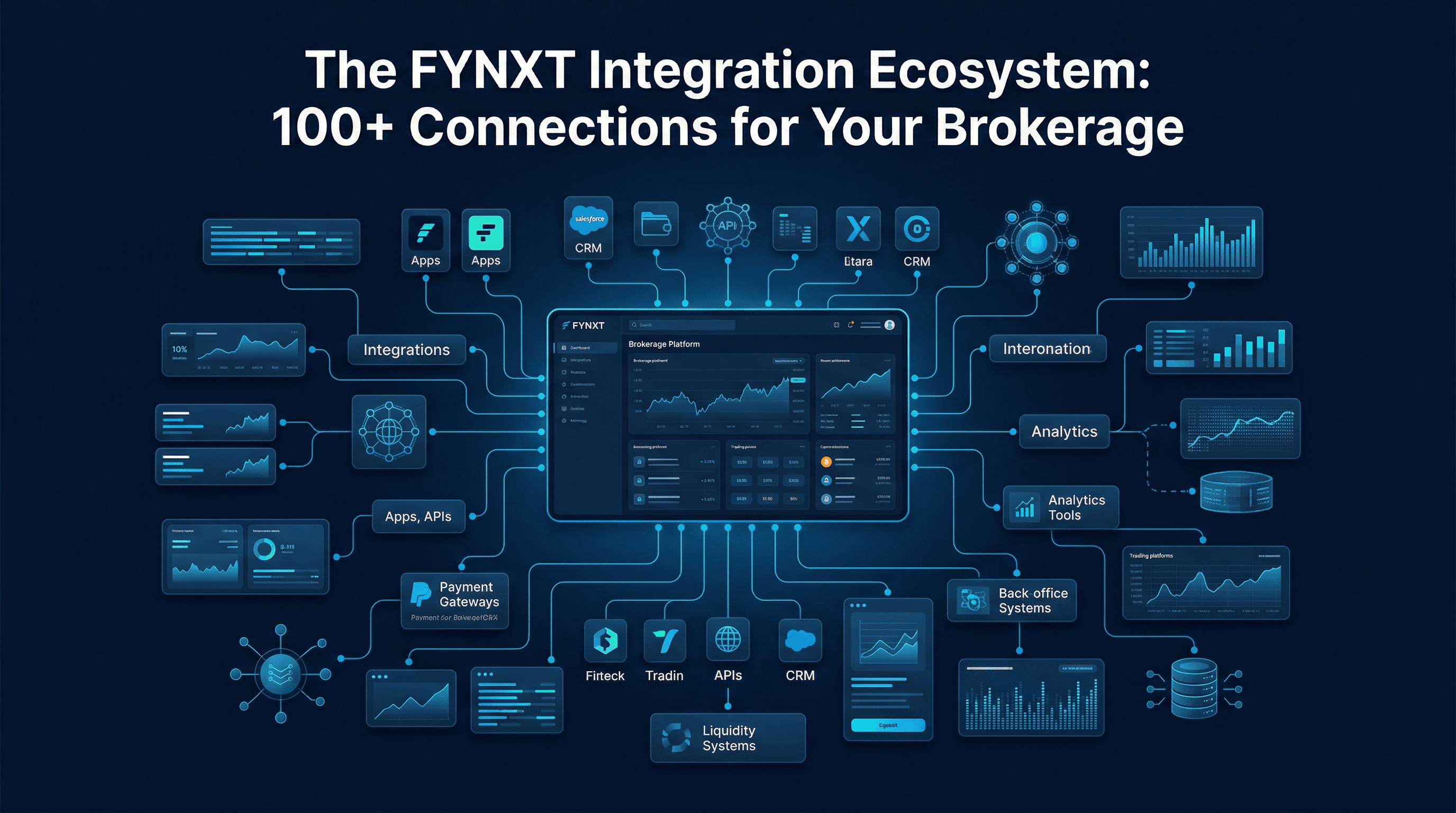
A forex broker's technology is only as strong as its integration ecosystem. Fragmented systems that cannot share data in real time create operational bottlenecks, compliance gaps, and poor client experiences. FYNXT's 100+ pre-built integrations span every layer of the brokerage technology stack:
| Category | Providers | Function | Count |
| Trading Platforms | MT4, MT5, cTrader, DXtrade, Match-Trader | Real-time account sync and trade data | 5+ |
| KYC / AML | Sumsub, Shufti Pro, GBG, iDenfy | Automated identity and compliance verification | 6+ |
| Payment Processors | Praxis, BridgerPay, Match2Pay, Stripe | Global deposit/withdrawal processing | 20+ |
| Communication Tools | Mailchimp, Convrs, Vaiso, Twilio | Email, SMS, live chat, marketing automation | 10+ |
| Infrastructure | AWS, Azure, Centroid | Cloud hosting, risk management, connectivity | 10+ |
Forex Broker Technology by Use Case: Which Components Do You Need?
The right forex brokerage technology stack depends on your current stage and strategic objective. Below is a practical guide matched to the three most common broker profiles searching for technology solutions:
I Am Launching a New Forex Brokerage — What Technology Do I Need?
For a new brokerage launch, the most time- and cost-efficient approach is a fully integrated white label solution. This provides all seven technology layers in a single deployment, allowing you to focus on client acquisition and marketing rather than infrastructure.
- White Label Solution (includes CRM, Client Portal, KYC/AML, IB Manager, PSP setup)
- Trading platform licence (MT4, MT5, or cTrader) — separate from FYNXT's stack
- Digital Onboarding for automated client verification from day one
- IB Manager if your go-to-market strategy relies on partner distribution
- PAMM or Copy Trading if you plan to attract passive investors at launch
I Am Migrating from an Existing Forex CRM Provider — What Should I Know?
Migrating your forex CRM is a significant operational undertaking but a necessary one if your current platform is creating bottlenecks, lacks integrations, or cannot scale with your business. Key considerations for a CRM migration include:
- Data portability: ensure your client records, trading history, and IB structures can be exported cleanly
- Downtime risk: select a provider with a documented zero-downtime migration methodology
- Integration continuity: verify your PSPs, KYC providers, and trading platforms will reconnect without manual rebuilding
- Staff training: budget 1–2 weeks of training time for sales, compliance, and operations teams
- Client communication: prepare a client communication plan for the transition period
Client example: Juno Markets — FYNXT's technical team completed a full CRM migration with "no downtime or confusion throughout the process", according to a Juno Markets representative.
I Am Scaling an Existing Brokerage — Where Should I Upgrade My Technology?
For brokerages that have outgrown their current stack, the highest-impact technology upgrades typically fall into three areas:
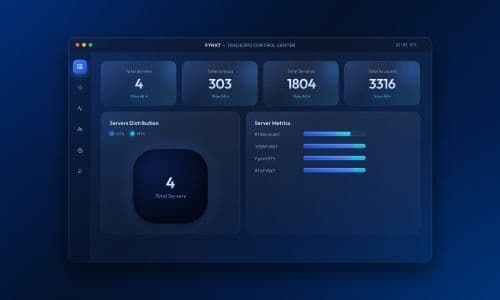
- MT4/MT5 Operational Automation: If your team spends significant time on manual MT4/MT5 account management, reconciliation, and error correction, FYNXT's Tradeops Control Center can reduce this workload by automating the most common operational tasks.
- IB Programme Scalability: If your IB network has grown beyond what a simple spreadsheet or basic module can manage, a dedicated multi-level IB Manager becomes essential for maintaining accuracy and partner trust.
- Investor Acquisition (PAMM/Copy Trading): If you want to attract passive investors and fund managers without increasing your sales headcount, adding a PAMM or copy trading module is the most scalable path.
Ready to Build or Upgrade Your Forex Broker Technology Stack?
| Get a Personalised Technology Consultation from FYNXT |
| Whether you are launching a new brokerage, migrating from a legacy provider, or scaling your existing technology stack, FYNXT's team of brokerage technology specialists can help you identify the right combination of modules for your objectives. |
| 📞 Book a Demo: fynxt.com/book-a-demo |
| 🖥 Free Product Tour: fynxt.navattic.com/xbh0jmh |
| 📧 Contact: [email protected] | HQ: Singapore | Offices: Surat · Chennai · UK · UAE · Philippines · Israel |
Frequently Asked Questions
Forex broker technology refers to the software systems an FX or CFD brokerage uses to operate — including the trading platform, CRM, digital onboarding, IB management, PAMM/copy trading, payment processing, and white label infrastructure. Together, these form the complete brokerage technology stack.
The best forex CRM for your brokerage depends on your scale, asset classes, and integration requirements. Key criteria include trading platform compatibility (MT4/MT5/cTrader), KYC/AML automation, IB management capability, PSP integrations, and the ability to customise workflows. FYNXT's Forex CRM has been independently recognised as the best CRM provider at Finance Magnates London Summit 2025.
With a fully integrated white label forex brokerage solution like FYNXT's, brokers can go live in as little as two weeks. This includes platform configuration, brand customisation, KYC setup, PSP integration, and IB programme configuration. Building from scratch typically takes 12–24 months.
PAMM (Percentage Allocation Management Module) pools investor funds into a single master account managed by a trader. MAM (Multi-Account Manager) mirrors trades across individual sub-accounts with customisable risk per investor. Copy trading automatically replicates a signal provider's trades into a follower's account. PAMM is simplest operationally; copy trading is most transparent for retail investors.
A forex broker CRM should integrate with: trading platforms (MT4, MT5, cTrader), KYC/AML providers (Sumsub, Shufti Pro, GBG), payment service providers (40+ PSPs), communication tools (email, VOIP, live chat), and cloud infrastructure (AWS, Azure). FYNXT offers 100+ pre-built integrations across all these categories.
A new forex brokerage needs: a trading platform licence, a forex CRM, digital onboarding and KYC/AML tools, an IB management system, a payment processing hub, and a branded client portal. A white label solution bundles all of these into a single deployment and is the fastest way to launch.
A white label forex brokerage solution is a pre-built, fully configured brokerage infrastructure that a technology provider deploys under your brand. It includes CRM, client portal, onboarding, compliance, IB management, and payments — all branded to your company. FYNXT's white label solution includes all these components and delivers a go-live in approximately two weeks.
MT4/MT5 operational workload — including account management, reconciliation, error correction, and reporting — can be significantly reduced through a dedicated Tradeops Control Center. FYNXT's Tradeops module automates the most time-consuming back-office MT4/MT5 tasks, freeing operations teams to focus on higher-value activities.
An IB Manager (Introducing Broker Manager) is software that enables a forex broker to manage a network of partner agents (IBs) who refer clients. It handles multi-tier hierarchy structures, automates commission calculations and payouts, provides IBs with a self-service performance dashboard, and integrates commission data with the main CRM.
Yes. FYNXT's platform is designed for multi-asset brokers and supports FX, CFDs, cryptocurrencies, equities, and futures within a single unified interface. This is a key differentiator from single-asset CRMs that require separate systems per instrument class. FYNXT integrates with the major multi-asset trading platforms including MT5, cTrader, and DXtrade.