
What is PAMM Software?
Share this article
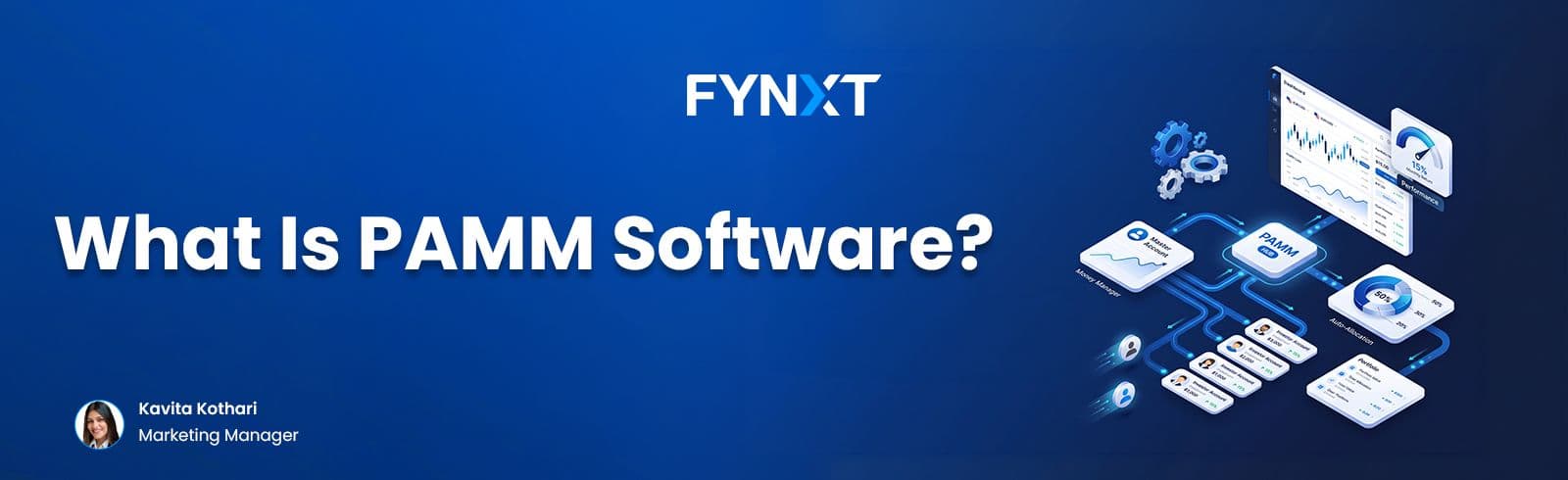
PAMM software is the technology a broker uses to let one trader manage pooled funds from many investor accounts and split the resulting profit or loss back to each investor in proportion to their share of the pool. PAMM stands for Percentage Allocation Management Module. The software handles the math behind that split. The broker still handles onboarding, compliance, and payouts.
The term comes out of the retail forex world, where MetaTrader brokers needed a way to let a single skilled trader run money for hundreds of smaller accounts without opening hundreds of separate positions. It has since spread to CFD brokers and a few crypto platforms, though forex is still where most of the volume sits. Modern PAMM engines run on MT4, MT5, and cTrader.
How Does PAMM Software Work?

The mechanic is simpler than the acronym suggests, and once you see one worked example the rest is just repetition.
An investor deposits funds into what’s usually called an investor account, then subscribes some or all of that balance to a manager’s PAMM strategy. The software pools contributions from every investor attached to that strategy into a single master trading account. The manager trades that master account as one position size. Nobody is trading investor A’s money separately from investor B’s money. It’s one book. Investors are read-only on the master, so they can watch but never interfere with the manager’s trades.
Here’s where the actual allocation logic matters. Say a manager’s PAMM strategy has three investors: one put in $15,000, one put in $35,000, one put in $50,000. Total pool is $100,000. The manager closes trades for a $12,500 gain before fees. The software doesn’t ask who “owns” that gain in dollar terms during the trade. It tracks each investor’s percentage share of the pool (15%, 35%, 50%) and applies that percentage to the profit. Investor one receives $1,875. Investor three receives $6,250. The performance fee comes out of each share before it lands.
When that split happens is the part worth checking closely. Legacy PAMM systems batch the calculation into a weekly or monthly settlement cycle, which means an investor’s statement can lag reality by days and mid-cycle exits get messy. Newer engines compute and apply every investor’s share the instant a trade closes. FYNXT’s PAMM module works this way: real-time settlement, zero rollover, so investors can join or exit at any time without waiting for the next settlement window.
Performance fees layer on top. Most PAMM setups apply a high-water mark, meaning the manager only earns a performance fee on gains above the previous peak. If the account is down 10% and claws back to 5%, the manager doesn’t get paid on that recovery. Good PAMM software enforces this automatically, per investor, because different investors join at different times and therefore carry different personal high-water marks inside the same pooled strategy. The better engines also let the broker choose when the high-water mark resets, such as at month end, at the weekend, or 30 days from each investor’s subscribe date.
Which Allocation Methods Does PAMM Software Use?

Four allocation methods cover nearly every PAMM deployment in production today, and mature software lets the fund manager pick the method per strategy rather than forcing one on the whole brokerage.
Proportional by Balance sizes each investor’s lot in proportion to their balance against the master balance. Predictable, straightforward, and easy to audit.
Proportional by Equity scales lot size with each investor’s current equity instead, so exposure stays balanced as account values fluctuate mid-trade. This is the method to reach for once investors deposit and withdraw on their own schedule.
Percentage Allocation allocates a fixed percentage of each investor’s account per trade, set once by the fund manager.
Fixed Lot gives every investor the same lot on every trade, regardless of account size or equity. It’s blunt, but some strategies want exactly that.
Precision matters more than it sounds here. An engine that computes allocated lots to 5 decimal places keeps small investors’ shares accurate; one that rounds coarsely leaks money in someone’s direction on every trade.
PAMM vs MAM vs Copy Trading
These three get lumped together constantly and they’re not the same thing.

PAMM pools capital into one master account and allocates each investor’s proportional share of every closed trade. MAM (multi-account manager) keeps each investor’s account legally separate but lets the manager execute one trade across all of them simultaneously, with allocation rules determining each account’s slice. The same four allocation methods above typically apply to both. MAM gives more per-investor flexibility, but it’s more complex to reconcile.
Copy trading is different again. There’s no pooling and usually no single execution event. Each follower’s account independently mirrors the lead trader’s positions, often with its own lot sizing and its own broker-side latency. It’s built for retail simplicity rather than institutional-style capital management. (FYNXT ships Copy Trading as a separate standalone module for exactly that audience.)
If your brokerage wants to attract professional money managers running real strategies for real capital, PAMM or MAM is the usual choice. Copy trading tends to serve a more casual, high-volume retail audience.
Who Does What in a PAMM Account?

A PAMM system has exactly two roles, and the software needs to serve both without either one getting shortchanged.
The money manager is the trader. They run one master account, trade it, and get paid based on the fee rules the broker configures. What the manager sees is aggregate: total pool size, current drawdown, current fee accrual. They generally don’t see individual investor identities unless the broker’s compliance setup requires disclosure.
The investor allocates capital and otherwise stays hands off. Investors need visibility into things the manager doesn’t care about: their own equity and virtual position view, their personal high-water mark, their historical statements, and clear withdrawal terms. A daily statement, generated automatically and formatted the way MT4/MT5 statements are, goes a long way toward preventing the support tickets and disputes that surface the moment a drawdown happens. A platform that hides this detail from investors, or bundles it into a single opaque statement, generates both.
What Should Brokers Look for in PAMM Software?

You’re evaluating vendors, so look past the demo and check the following:
- Allocation method flexibility. Confirm the platform supports all four methods (proportional by balance, proportional by equity, percentage allocation, fixed lot) and lets the manager choose per strategy. FYNXT’s PAMM allocation engine covers all four with lot precision to 5 decimal places.
- Real-time settlement. If P&L only applies at a weekly or monthly rollover, investors can’t cleanly join or exit mid-cycle and statements lag the market. Zero-rollover engines remove that entire class of dispute.
- Fee engine depth. Performance and management fees are table stakes. Deeper engines add entry, exit, administration, and volume fees, toggled independently per strategy. FYNXT runs 6 fee types, 3 of which (administration, entry, and exit) it ships as exclusives, with settlement periods set per strategy rather than per platform.
- Per-investor high-water mark tracking, not just an account-level one. If the system can’t isolate high-water marks per investor, fee calculations will be wrong for anyone who joins after the account has already made money.
- Built-in investor protection. Automated margin call alerts (30% free margin is a sensible default) and auto stop-out (20% is common), both configurable per strategy, plus partial withdrawal at any time with fees pro-rated on exit.
- A real investor view with statements, current allocation, and withdrawal status, not a shared dashboard that mixes manager and investor screens.
- Reporting exports that satisfy whatever regulator you answer to. What counts as adequate disclosure in one jurisdiction is not adequate in another.
- CRM integration, so investor onboarding, KYC, and IB commissions don’t require a second system. A CRM-native PAMM (one login, one data model) closes the integration gap that plagues bolt-on bridges.
For a side-by-side comparison of vendors against this list, FYNXT’s best PAMM software for 2026 roundup is a reasonable starting point.
Want to see the allocation engine on your own MT4/MT5 or cTrader stack? Book a Demo.
How Do Brokers Use PAMM to Grow AUM?

PAMM is mostly a retention and acquisition tool dressed up as a trading feature. A broker that recruits a handful of consistently profitable managers, gives them a track record page and a fee structure, effectively turns those managers into a sales channel. Investors who wouldn’t open a self-directed trading account will deposit into a manager they trust, and that deposit stays with the broker as long as the manager keeps trading there.
The AUM growth comes from three directions. New investor deposits add to the pool directly. Manager performance, when it’s good, pulls in more investors through word of mouth or through your own marketing of top-performing managers. And your IB network can become a distribution channel in its own right: platforms that connect fund management to the IB layer let IBs create and promote strategies and earn multi-level performance fees automatically, which gives partners a reason to push PAMM rather than just referral links.
The failure mode is just as common. A broker signs up managers without vetting track records, a few blow up accounts, investors lose money and leave bad reviews, and the PAMM program becomes a reputational liability instead of a growth channel. The software doesn’t fix bad manager selection. It just makes the consequences visible faster.
FYNXT’s PAMM module covers the allocation, fee, and protection mechanics described above, settles in real time, and lives inside the broker’s existing CRM rather than a second vendor’s portal. If you’re building or replacing a PAMM offering, Book a Demo
Frequently Asked Questions
No. PAMM originated in forex but CFD brokers and some crypto platforms use the same pooled-allocation model for equities, indices, and digital assets. Most production deployments still run on MT4, MT5, or cTrader.
It depends on the engine. Legacy PAMM systems lock withdrawal requests to weekly or monthly settlement dates. Real-time settlement engines such as FYNXT’s PAMM allow partial withdrawal at any time, with fees pro-rated and settled on exit.
Usually not. Most PAMM software shows managers only the aggregate pool size and performance, keeping investor identities visible to the broker’s back office rather than the manager.
With a properly configured high-water mark, the manager earns no performance fee until the account recovers past its previous peak balance for that specific investor. Fees apply to new gains only, never to recovery.
Not legally. A PAMM account is a brokerage arrangement between a manager and investors within one broker’s platform. A managed fund is typically a separately regulated investment vehicle with its own custodian and fund documentation.